My Board Game: Zeppelins vs. Pterodactyls

Months ago, I watched a bizarre short film called Zeppelins vs. Pterodactyls which threw together clips from various cartoons and space opera serials of the 1930’s. The film didn’t do much for me, but the name stuck.

I mentioned that name to Michael R, and we fantasized a competitive board game in which zeppelins fly over a lost world, descending for treasure as their crews fight off pterodactyls.

Today, after much play-testingthat game is officially born:
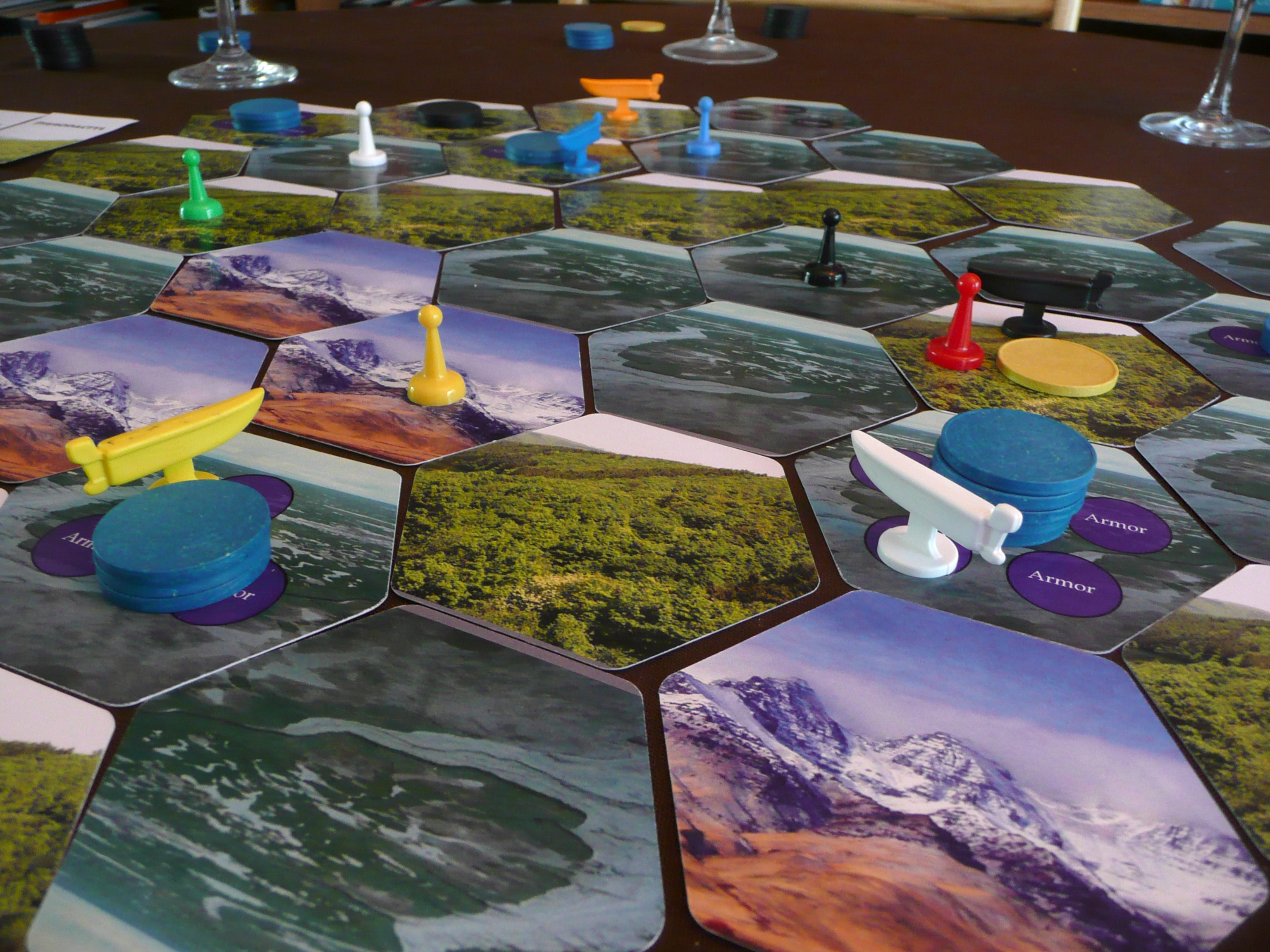
Zeppelins vs. Pterodactyls action shot

Zeppelins vs. Pterodactyls action shot

I spent several months play-testing the concept, discovering confusing rules and improving gameplay. It’s always had the same basic concept: the players lay out terrain cards to form a lost world, then each player controls a zeppelin. On your turn, you move your zeppelin to an adjacent card or attempt to steal the loot on the terrain card below you. If you move onto an unexplored card, flip it over to reveal its loot: extra cannon balls, extra armor, or a treasure. You can also fire a cannon ball at one of the pterodactyls flying around. Separately, all the players move pterodactyls and cause them to attack nearby zeppelins.

A lot has changed. The terrain cards were initially square (hexes get around the question of diagonal movement and look cool). Early iterations had a lot of empty terrain cards; now there are no empty terrain cards, but some with minimal rewards. Controlling pterodactyls went through many iterations before I hit on the current system that involves flipping over a pterodactyl card on your turn to control that pterodactyl. I also tried several ways for players to track armor and cannon balls, from setting a 20-sided die to the current number, to placing stones on a paper track, to the current system of tokens.

As with my 50 Games in 50 Weeks challenge (and this counted as one of the games!), I learned a lot:

  • Rules must be airtight, written without ambiguity.
    • Much play-testing experience is needed to learn which phrases people find ambiguous.
  • Players benefit from a summary of the rules that can be used during play. Ideally, this summary fits on a card or one side of a sheet of paper.
  • A game will not appeal to everyone.
    • Better to create multiple versions of a game to appeal to different demographics than to attempt one game for everyone.
  • We now live in a world where I can upload a bunch of images and text to The Game Crafter, and within a few minutes, anyone in the U.S. can buy my game.

Zeppelins vs. Pterodactyls is a family game for 1–6 players that plays in 30–60 minutes. If you’d like a copy, it’s US$30 on The Game Crafter.
50 Games in 50 Weeks: Shadowrun 4E

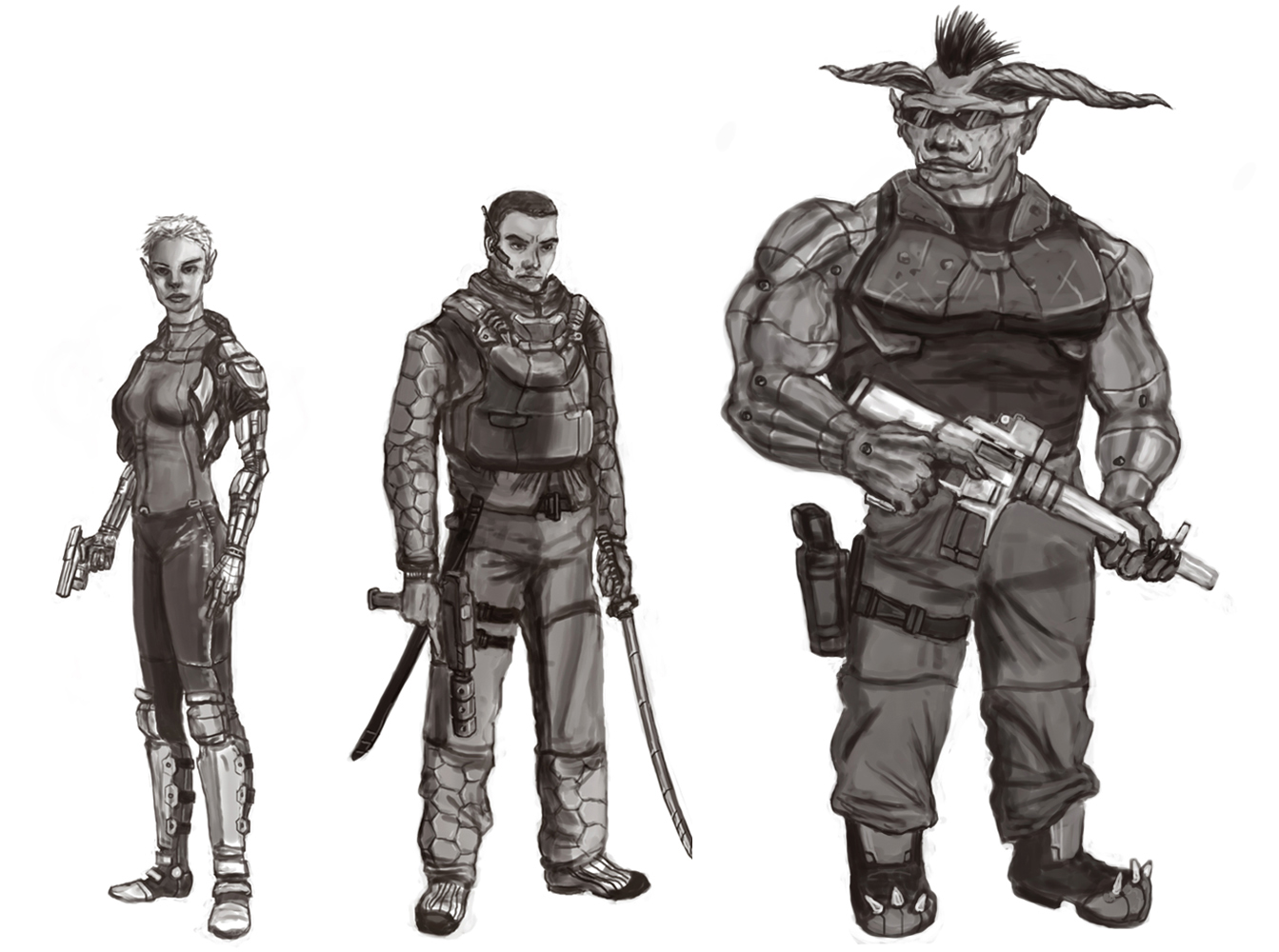
Shadowrun on My Mind by John McKenna

Shadowrun on My Mind by John McKenna

I’d heard bad things about Shadowrun, that the world was much more fun than the system.

Fortunately, I played 4th Edition, which made complete sense. Character sheets were heavy-laden with skills and stats, but easy to understand.

The system features a straightforward core mechanic: assemble a die pool out of your abilities and roll it against a target number. If you roll a lot of 1s, something really bad happens.

The system benefits from many years of evolution. I felt like the system started with a heavy emphasis on crunch, then over time the more complex parts were re-factored out and storytelling elements were worked in. The current incarnation can handle crunch-heavy and crunch-light games with ease.

I also had the good fortune to play under an awesome GM. He knew the system, he knew the adventure, and he was completely open to player actions. He listened.

We finished in about two hours, which was half of our four-hour slot at Origins. The GM apologized, and offered to throw other stuff into the adventure; we players thanked him and politely declined. We were happy to have some extra time at the con, especially after a fantastic, memorable session. Much better to play a great two-hour session than a four-hour slog.

I don’t actually remember much of the system; I mostly remember having a great time. Isn’t that awesome?

50 Games in 50 Weeks, Complete

'Game closet' by lkbm on Flickr

‘Game closet’ by lkbm on Flickr

In July of last year, I took stock of myself as a gamer. I wanted to understand games better, and eventually design games. I realized that I suffered from a deficiency: I could play a few games well, but I knew only a few of them.

I decided to fix this by setting myself an impossible-sounding challenge: 50 Games in 50 Weeks. I would play 50 games that I had never played before, all within the next 50 weeks.

Last night, at the stroke of midnight on the last day in June, I finished my fiftieth game: Houses of the Blooded.

Looking back on the past year, I’m struck by a few things:

  • There’s a huge variety of games and mechanics. I feel like I’ve plunged two feet into the ocean.
  • I have learned a lot. I’ve discovered many different mechanics and rule approaches. The challenge worked.
  • In a “bad” game, the mechanics don’t fit the kinds of actions the players want to take. Indeed, the mechanics are often the same generic mechanics used in popular games. “Good” game design involves finding appropriate mechanics and fitting them together in ways that fit the game’s concept and offer the players interesting choices.

I do realize that I’ve fallen behind in posting my game summaries; I’ll write and post those in the coming months.


Best of Many Worlds: Indie+

Dice illusionRole-playing games let people tell stories. At their best, RPGs encourage imagination and open us up to new experiences that we tailor to our own needs and desires.

This is strengthened by the recent trend of “indie” RPGs, many of which include in-game rewards for moving the story forward and otherwise making things complicated for the characters.

Indie RPGs have always had a fundamental problem: exposure. Tabletop RPGs are already a niche market, with indies huddled in a small corner.

Along comes Indie+ to pull indie RPGs out into the limelight.

Indie+ is an online convention planned for the week of July 9 through July 15. Hosts will run a variety of indie RPGs, from the space marine game 3:16 to the Tarantino film simulator Fiasco to the classic dungeon crawl system Searchers of the Unknown. There’ll even be panels about defining “indie,” art from the buyers’ and the makers’ perspectives, and depictions of women in RPGs.

Since it’s entirely online, all you need is a microphone of some kind (and a Google+ account) to attend. We’ll even run everything through Google+ Hangouts on Air, so video should be available afterwards of all games and panels.

Yes, I wrote “we;” I’m helping to organize the con. I think this is a great chance to broaden one’s horizons, and I hope you’ll sign up for a game!

Doc

In an attempt to counteract the emo tendency of my previous posts, time for some content.

I’ve been in a mood for documentaries. We live in a golden age for them, and here’s what I’ve watched recently:

Sin Cities Legendary Sin Cities — A CNBC retrospective on the three infamous “cities of sin” of the 1920’s and 1930’s: Paris, Berlin, and Shanghai. Fortunately, the filmmakers take pains to explain the socio-economic forces that brought in all the prostitues and drugs, as well as the forces that ended those eras (Black Thursday, the Nazis, and the Japanese, respectively). We live in such a fascinating world. Bonus: if you’re looking for inspiration for a story or game, you’ll find societies ripe for adventure here.
Dr. Bronner's Dr. Bronner’s Magic Soapbox — I buy an all-natural liquid castile soap. The label is a densely-packed religious manifesto (example: More good is caused by evil than by good, do what’s right! Enlarge the positive! Replace the negative with the Moral ABC’s ALL-ONE-GOD-FAITH, that lightning-like unites the Human race! FOR WE’RE ALL ONE OR NONE! “LISTEN CHILDREN ETERNAL FATHER ETERNALLY ONE!” WE’RE ALL ONE OR NONE! EXCEPTIONS ETERNALLY? NONE!!”). The film begins with Dr. Bronner’s son Ralph, then dives into the history of the soap and Dr. Bronner himself, weaving its way through Nazi Germany, the hippy movement, the FBI, and electro-shock therapy. It’s an intimately human story about eccentric people who are just trying to do what they think is right.
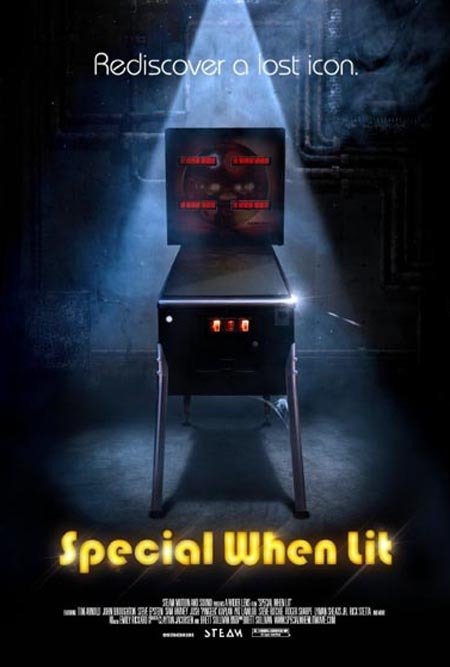
Special When Lit Special When Lit — A documentary about pinball, from its early days to its nadir today. Did you know that pinball machines were illegal in the U.S. for 30 years? This film covers a lot of territory, to the point that it becomes a bit unfocused; I found its profiles of today’s “major” American pinball championship players uninteresting. Overall, though, it’s fair while celebrating its subject, and doesn’t shy away from the near-certainty of pinball’s demise.
American Scary American Scary — An exhaustive documentary about American “horror hosts,” those people who would cover themselves in cheap make-up, get on TV late at night, and introduce schlocky horror movies. Every single one had a child-like love of horror hosting, including folks who stopped thirty years ago. I’ve never seen a happier collection of folks. The filmmakers even include Joel Hodgson and Mystery Science Theater 3000 as an extension of the concept.

What have you been watching lately?

Points

As I mentioned in my last post, I feel lost. Not depressed; just unmoored. So I’ve been thinking about how I want to spend my time.

That’s a clichéd phrases and an important thought. How do I actually spend my time? What do I actually do every night?

I work on lots of little things. I keep up with Google+ and email. I chat on IRC.

That’s not how I want to live my life. Unfortunately, I don’t know how I do want to live my life. So I’ve been experimenting.

On Wednesday, I met a friend at a nice restaurant. I arrived about an hour early (work ended early and traffic was merciful) and wandered into a nearby stationery store. My eyes flickered over the explosion of colors, and were drawn to a wooden counter stacked with new copies of old games. I ran my fingers over the wares on display, particularly a wooden transformer which I now want to build myself.

I bought a set of jacks. I chose them for one reason: there are no jacks tournaments. No jacks leagues or rankings. There are no international jacks competitions. It’s the least competitive sport I know of.

I’ve played and practiced a couple of times, nervously. It feels strange to play a game that I’m playing just to play. A game that’s just there.

I think I’m going to be just there for a while.

No More

Good gravy, I’m tired.

'Mist' by frielp on Flickr

‘Mist’ by frielp on Flickr

I’m tired of outrage.

I’m tired of walls.

I’m tired of anger.

I’m tired of working late into the night on yet another project. Because everybody’s busy. So what are you working on?

I’m tired of feeling tired.

This exhaustion is thanks to a wonderful Monday night with historicula (not in that sense!). We saw Snow White and the Huntsman, which lived down to its reviews, and afterwards we talked for hours. I laid out my recentre-evaluations of my life. She provided excellent advice (no surprise there).

I’m tired of this. I’m tired of always striving for my artificially high standards. I’m tired of staring into a glowing rectangle, hoping to find satisfaction there.

I realize I’m whining. I think I’m allowed one rare emo post.

I spent this evening eating fish and chips at a local restaurant, then reading an odd book, then watching a documentary about horror hosts. A complete “waste of an evening” to yesterday’s self.

Today, I think differently.

Advice Taken

It’s 1:00am. I’m writing a distressing number of these posts after midnight.

A few days ago, my Google+ stream gave me this video of photographer Scott Kelby.

[iframe_loader width=”500″ height=”300″ src=”http://www.youtube.com/embed/FpHMuK7Htic” frameborder=”0″ allowfullscreen]

In the video, he exhorts a room full of photographers to understand the basics of photograph composition. He spends no time on lenses or cameras; he explains concepts like the Rule of Thirds and filling the frame, then walks through his experiences of “working a scene,” looking for a good shot. My eyes opened as if newborn to photography.

I knew that if I just said “Awesome!” and went on with my life, I’d forget what I learned. So I’ve re-watched the video every day, and I’ve taken photowalks every day. Today, I took my tripod along. Scott’s advice improved my photography at least twofold:

[iframe_loader align=”center” src=”http://www.flickr.com/slideShow/index.gne? group_id=&user_id=15404046@N02&set_id=72157630155115932&text=” frameBorder=”0″ width=”500″ height=”400″ scrolling=”no”]

I have Walked the Deserts with Aurens

One advantage of a client with stringent child care requirements: she leaves at 4:30pm, so we’re done, thank you.

I drove from the client site back to my hotel along highways that have become familiar over the past few days. I wonder how comfortable I’ll be driving around foreign cities a few months from now when I’ll be doing this alone.

The weather certainly won’t be this fine: 70 degrees Fahrenheit, a sky almost cloud-free, with an occasional sighing breeze. I found a local restaurant that had 1) good food, 2) reasonable prices, and 3) outdoor seating. I planted myself in a chair, ordered a chicken sandwich, and pulled out my Kindle, breathing a little fast in anticipation. I was near the end of T.E. Lawrence’s Seven Pillars of Wisdom.

Lawrence and a camelThis is part of the Classic Literature Project I mentioned early this morning. And by “near the end” I mean “within 50 pages,” as the paperback edition has over 500 pages. The size is due to its history: this is the first version of the memoir Lawrence assembled from his journals and notes. After reviewing it and thinking further, he pared and re-wrote it into The Revolt in the Desert, which has greater punch and less subtlety. Revolt feels like an action movie; Seven Pillars feels like a war, with all its triumphs, frustrations, squabbling, self-doubts, tragedies, ironies, and fortune.

Lawrence’s sharp, beautiful prose lifts his account from recollection into true literature. I found myself re-reading passages not from confusion, but to appreciate the beauty and economy of his composition. A representative sample follows:

We started on one of those clean dawns which woke up the senses with the sun, while the intellect, tired after the thinking of the night, was yet abed. For an hour or two on such a morning the sounds, scents and colours of the world struck man individually and directly, not filtered through or made typical by thought; they seemed to exist sufficiently by themselves, and the lack of design and of carefulness in creation no longer irritated.

Here are the final words of the book, other than his summarized epilogue:

I made to Allenby the last (and also I think the first) request I ever made him for myself–leave to go away. For a while he would not have it; but I reasoned, reminding him of his year-old promise, and pointing out how much easier the New Law would be if my spur were absent from the people. In the end he agreed; and then at once I knew how much I was sorry.

May I someday write like that.

The Dark Hotel Room

I’m sitting up in a hotel bed at two o’clock in the morning. The room is dark. The hotel’s silent. This would be a good start to a Stephen King novel.

And books are on my mind. I recently posted this photo of my (physical) to-readpile on Google+:

My to-read pile

In contemplating that mountain of wood pulp and ideas, I came to a realization: I should be smarter about my reading.

What would be wisest to read? That question bounced around my head for a few days. I quickly discarded misgivings about the subjectivity of wisdom and absolute knowledge.

I’ve decided to read the classics. I want to read the “foundational texts” of literature, philosophy, biography, history, etc.

There’s no end to such lists, naturally, so I found one list from The Telegraph that includes a reasonable cross-section of established classics, and loaded up my Kindle. I read the Nibelungenlied, and am now a few hours away from finishing T.E. Lawrence’s Seven Pillars of Wisdom.

The most interesting part of this project so far has been its effect on my judgment of other people. I’m already far too judgmental, and this project hasturbo-charged that tendency when I see how other people use their time.

I see blogs filled–yes, literally filled–with excited posts about comic book movies and pop music. Of course, there’s nothing wrong with comic book movies–I watched and loved Bunraku last weekend, which is the closest thing I’ve ever seen to a live-action comic book–but I see a lot of people who fill their spare time withgeek-outs about Batman movies or grunge music.

However, it’s not my job to fix people. They’re not even doing anything wrong. This is my judgmentalism grumbling that other people don’t spending their time as well as I do.

It always comes back to the self.

I work for Amazon. The content on this site is my own and doesn’t necessarily represent Amazon’s position.