How to Find Channel Comments on the New YouTube Design (December 2011)

Bottom line up-front: Click on the Feed tab, then below the Post a bulletin text box, click the view button and select comments only. Your channel comments now appear.

For the record, I like the new design: it’s clean and mostly clear. The information is laid out in a reasonable and logical structure. I like that stats and info are near the top of the page but grayed out. I want that information to be easily available, but not distracting.

Not sure why channel comments are so tucked away. Perhaps because they’re so often content-free?

50 Games in 50 Weeks: Catego

Catego is an abstract dice game in which several players (about 2 to 5) each roll dice, and slowly fill in a scorecard, jockeying for position.

The scorecard looks like this:

2 3 4 5 6 7 8 9 10 11 12
Player 1
Player 2
Player 3
Player 4

Every turn, each player rolls two six-sided dice, adds them, and places that result in one of the columns in their row.

Here’s where strategy enters: The player with the highest number in a column wins that column, and all the numbers in that column (including the header) are added to that player’s score. So, columns farther to the right are more valuable than the left-hand columns.

As with any game, one’s enjoyment of Catego is proportional to one’s expectations. Catego remains interesting beyond the first few games, but would begin to wear thin after several dozen.

The weighting of each column adds important complexity. After the random die roll, the player must decide whether to lock up a low-scoring column or struggle for a high-scoring one. Each roll presents the player with several interesting options, which diminish alarmingly as the game draws to its close. The rules nicely balance random chance with strategy.

Moreover, players of almost any age can learn Catego in a few minutes, and its strategy reveals itself in play.

However, Catego is not Risk. Play can grow repetitive, and the lack of anything except abstract, black-and-white numbers can feel exhausting. That is not, of course, its fault. But it’s still true.

On the whole, though, Catego hits a lovely balance between extremes, as a game that’s easy to teach, slightly unpredictable, and strategic.

Catego was originally published in Reiner Knizia’s book Dice Games Properly Explained.

Halloween Music Challenge!

There’s a lot of terrible Halloween music out there: fake “horror” sound effects set to Casio keyboard demo music and banal lyrics.

Here’s part of my Halloween playlist to get us started. What’s your favorite Halloween music?

Halloween music

I’m in a Night in the Lonesome October

jffdougan has kindly accepted my submission to his blog carnival A Night in the Lonesome October, “The House of Doctor Chamberlain.” Not only that, it’s the second entry! I’m honored.

The other entries so far include is a “charmed hero” theme and a neat set of “cultist” themes for D&D 4th Edition, so there’s already some cool content out there. Hope you follow the carnival!

Exploring The Lost Kingdoms

Michael Garcia’s The Lost Kingdoms is a GM aid, meant to provide a ready-to-use framework for a typical fantasy kingdom.

And that is its biggest problem.

On the one hand, The Lost Kingdoms may be useful for new GMs who want a generic fantasy town with the barest bones of backstory. The setting’s background–wild kingdoms locked away behind a gate, recently re-opened for adventurers–is a great idea. The document lists a few common locations–a tavern, a weapons shop, a general store, several temples, etc.–each with a paragraph or two of basic information.

On the other hand, who wants to adventure in a generic fantasy town?

However, there’s not enough detail in The Lost Kingdoms to raise any of its contents to life, and what does exist should be easily imagined by any GM. Do I need someone to tell me that my town has a weapons shop? If the players need one, I can just say “Yes, there’s a weapons shop.” The meager information provided in the shop’s description (that it’s run by “a very well-known pair of Dwarf brothers”) could just as easily be re-imagined.

Worse, the book’s naming hurt my brain. Most places in town have deliberately generic names, like Apothecary and Inn, but the town square is named Statdplatz. Areas of exploration are given names that sit uncomfortably between generic and specific, like Edge Mountains, Morning Mountains, Crystal Lake, and Wasted Sands.

And the emperor who unsealed the gate? Bob the Magnificent. It just jars.

To top it off, the last page refers to “the awesome random encounter chart which I also provide,” which I can’t find anywhere in the book.

Even at its current $0.99 price, I can’t recommend The Lost Kingdoms. What’s here is too generic and weirdly named to be useful.

50 Games in 50 Weeks: Risus

I had the good fortune to play a game using the free Risus “everything RPG system” as part of DC Gameday this year.

Risus is very generic, which is its key strength. The system can be explained in two short paragraphs, which I will now attempt to do.

Each character is made up of clichés, each of which gets 1 to 4 dice. Each character has a total of 10 dice to distribute amongst clichés. You can add a “hook” (interesting backstory) to your character for an extra die.

To attempt an action, choose a cliché and roll that number of dice. Add the result (rolling 3, 4, and 4 results in 11); if you meet or beat a target difficulty number, you succeed. If you fail during a conflict, remove one die in that cliché for the rest of the conflict; if you lose all your dice in one cliché, you lose the conflict. You can also “team up” to assist a team leader, by rolling one cliché’s dice and adding all the sixes you roll to the team leader’s roll.

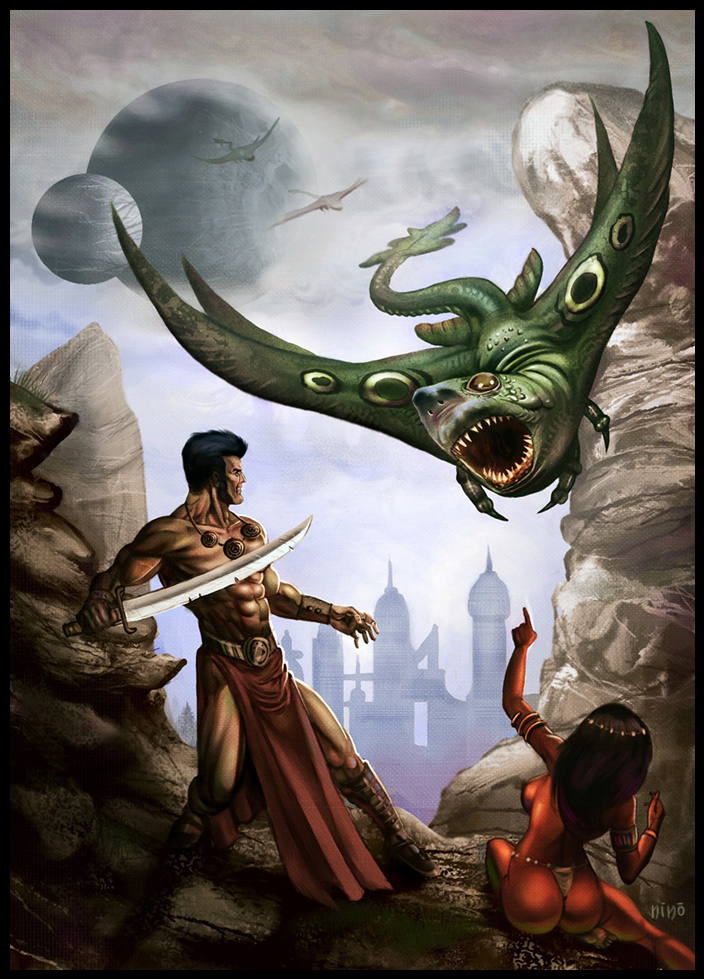
'John Carter of Mars' by artmessiah on DeviantArt

'John Carter of Mars' (c) artmessiah on DeviantArt

Our game was a Flash Gordon-style story, set in a garden party on Venus. The cast was as follows:

  • An arrogant spaceship captain (think Zap Branigan)
  • An ace reporter
  • A Robby the Robot-style robot
  • A slightly mad professor
  • A spunky female hover-limo driver
  • A femme fetale

We had an excellent group; people were throwing ideas out and actively playing. Unfortunately, though we raced after the mad Moon Men, we were unable to complete the story in time.

Risus is a flexible and straightforward system that struck me as easy to play and easy to GM. Opposed actions are against other characters’ clichés. At most, you’re rolling a couple of dice and adding the result. Boom.

Download Risus

Let’s Play an Interesting RPG: The Beginning

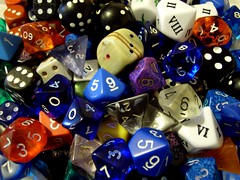
'Dice' by jamesrbowe on Flickr

'Dice' by jamesrbowe on Flickr

I suggested on #4eDnD that we organize an online group to play different, interesting games every week. We’d focus on trying out new things, but could certainly play the same system a couple weeks in a row if we felt that was worthwhile.

I’m pleased to announce the first session:

When: Friday, 21 October 2011, starting at 7:00pm Eastern Time

Where: Google+ Hangout. Make sure to circle me.

System: Dresden Files. You will not need to own a copy of the rules to play. We’ll create characters and define the setting during the session.

Signing up: Either leave a comment on this blog post, or join the Yahoo! group and add a record to the database table for this game.

Cleaning Out

Spent a good chunk of last night reading It’s All Too Much, based on a recommendation from Merlin Mann on the “Back to Work” podcast.

It’s an excellent, kick-in-the-butt response to having too much stuff, and guides the reader through ways of tossing out a lot of it.

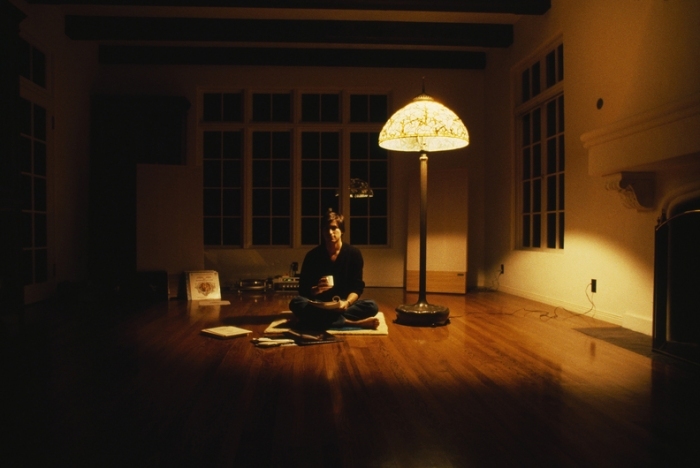
I was inspired by this image of Steve Jobs, way back in the day:

This was his apartment. He was a millionaire at the time this photo was taken.

So, I tossed a whole lot of things yesterday. Piled up some of it for Goodwill; the rest will go away. I’ll be free of it. Time to focus.

50 Games in 50 Weeks: Seven Dragons

Just finished playing a game of Seven Dragons, a strategy card game by Looney Labs. It manages to find an excellent middle ground between ease of comprehension and strategic options.

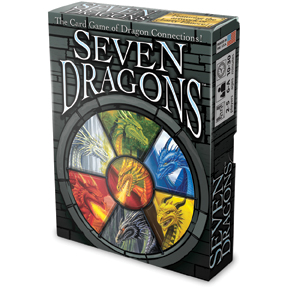
Seven Dragons card game

Seven Dragons © Looney Labs

The rules can be easily explained in 10 minutes (though I botched one of the rules’ aspects). After you begin playing and once you hit the game’s midpoint, your strategic options become complex and interesting.

It’s something of a pattern-matching game. A silver dragon card is placed in the center of the table, then each player draws 3 dragon cards and one goal card (all kept secret from other players). The dragon cards have differently-colored dragon panels on them, and the goal card has one colored dragon. Each turn, each player draws a card into their hand, then lays down a card next to an existing card on the table, with the goal of connecting seven panels that all have the same color as the player’s goal card.

The draw pile also contains action cards that let players swap goals, swap hands, move a card on the table, etc. This makes the latter half of the game particularly intense, as chains built earlier are abandoned for new goals and precise placement becomes much more important to prevent other players from completing chains.

It’s not Risk, of course, but for a US $12-$15 game that you can teach quickly and get through in 30 to 60 minutes, I’m impressed at its depth. Bonus: elements of the system can be easily dropped to make the game easier for kids to understand.

You can buy Seven Dragons directly from Looney Labs.

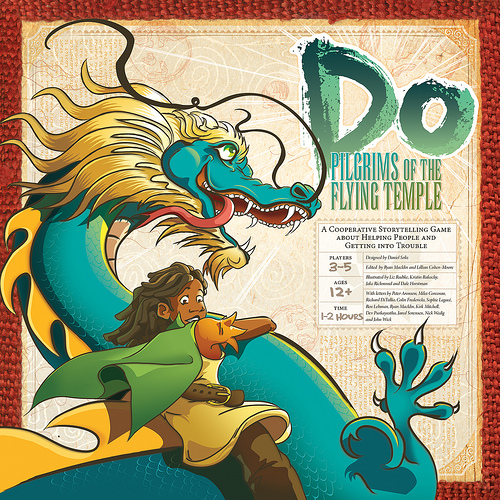
50 Games in 50 Weeks: Do: Pilgrims of the Flying Temple

Do: Pilgrims of the Flying Temple

Do: Pilgrims of the Flying Temple

Do simulates a specific fantasy trope: adolescent temple iplgrims who travel the world, helping people and getting into trouble. As limiting as this may appear, it’s easy for folks to grasp and use to tell stories.

The system is much more simple than the length of this review implies, and highly story-focused. Your character is represented by two words: an adjective or verb “banner” and a noun “avatar.” The banner represents how your character gets into trouble, and the avatar represents how she helps people.

That’s it for character creation. There’s no GM, and no combat system. Intrigued yet?

Each story begins with the pilgrims’ receipt of a letter from some community outside their temple. The letter describes some big problem that the community faces (though the letter writer may not be telling the whole truth). From that letter, a set of key words called “goal words” (10 for an easy adventure; 20 for a normal one) have been extracted. The book provides a bunch of sample letters, with goal words pre-extracted.

The system uses no dice; instead, several dozen stones are placed inside a pouch. Black and white go stones are ideal; we simulated them using coin tosses.

Once the pilgrims fly off towards the source of the letter, play begins with the oldest player, then continues to the left in a circle. The current player is the “storyteller,” while the other players are “troublemakers.”

The storyteller removes three stones from the pouch, and decides whether to take the white or the black stones. Taking the larger number lets you help people and get out of trouble while fewer stones get you into trouble, but once any player collects 8 or more stones, the story is over and the group fails.

Practically speaking, if you take as many stones as possible each turn, you’ll collect too many stones. So, there’s a built-in incentive to get in trouble.

The only part of the system that can’t be quickly memorized is the table that tells you what you do depending on how many stones you take.

That table determines what the storyteller or the troublemakers do next, and it’s determined by how many stones you take and whether you are or aren’t in trouble (a total of 8 scenarios). The storyteller may be able to help someone–perhaps another pilgrim who’s in trouble, or perhaps someone in the world they’re visiting–or the troublemakers may be directed to get the storyteller into trouble. Either (or both) may involve crossing off goal words.

Crossing off goal words is how you get a happy ending: if you cross off all the goal words before any pilgrim gets 8 stones, the pilgrims succeed.

After a few rounds, it becomes clear that the pilgrims are regularly getting into trouble, and each player must, while storyteller, balance helping her friends and moving the story along towards its goal.

There’s a bit more complexity involving the stones you take and how your character changes at the end of the story, which appears lovely but I wasn’t able to test.

The book’s cover claims that it’s aimed at players 12 or older, but I think it’s ideal for kids as young as 8. It’s basically Avatar: The Last Airbender, without the heavy long-term story arc.

Moreover, the system is supported by beautiful artwork that evokes child-like wonder and fantasy awesomeness. This is a book worth owning just for the art; combined with the system it was well worth every penny.

I work for Amazon. The content on this site is my own and doesn’t necessarily represent Amazon’s position.