I’m off on the first day of my great

I’m off on the first day of my great
I’m careful to avoid announcing new products until they’re evolved enough that I’m sure I’ll be able to release them.
I have 38 pages and over 10,000 words in this one, so I’m confident now.

Flying Imp, Elven Spelljammer by juanosarg on Flickr
I’m working on a SpelljammerTM adaptation for Dungeons & DragonsTM 4th Edition. Its working title: Voidjumpers of Space.
First, a few definitions:
Spelljammer was a D&D 2nd Edition supplement for running D&D adventures in outer space. Wooden sailing ships flitted through the spaces between worlds.
This will not be Spelljammer with the serial numbers filed off. This is not a
Here’s what I’ve got so far:
I’ve also statted out several dozen specific monsters and potential enemies. I want this to give you plenty of material to work with, which you can either drop in directly or easily modify to suit your tastes.
When will it be released? When it’s ready. I’ve got a lot of playtesting and massaging of the text remaining.
I’ll post more as I firm up the content. Meanwhile, I’m open to suggestions. Let me know what you’d like to see in the final product!
 Fortune & Glory is a new board game of pulp adventure. Each player is an Indiana
The board shows the world, split up into maybe two dozen zones for major countries and areas.
Each player gets a specific character card to play, each of which has a couple of stats. The game includes a bunch of different card types, several of which are used to generate treasure and place them in locations around the world board. Each character starts out in his or her home city.
The mechanics are all based on cards and
If one or more characters are in a country that has a treasure, they each start going through dangers. Each treasure lists the number of dangers required to acquire the treasure, and the amount of glory points you get for successfully going through all the dangers.
 Each danger card lists the challenge (rock slides, pit traps, thugs, plane crash, hostile natives, etc.), and the abilities that can be used to overcome it. I love the notation for this:
Lore (5+) • •
This means you need to roll the number of dice you have in your Lore attribute. Any rolls of 5 or above are successes, and you need 2 successes (the dots). Clean and clear.
If you succeed, you can stop for this turn or push forward with another danger. If you fail, you may take damage, or you may fail the entire challenge, in which case you flip the danger card over to reveal the Cliffhanger you must face next turn. No matter what happens on the Cliffhanger, you must start the challenge over again.
Collect enough damage and you’re sent back to your home city (which may not be a bad thing, depending on where the treasures are on the board).
You get glory points for completing each danger, and for collecting treasure. You can travel to any of the cities on the world board to transmute your glory points into fortune points. Whoever gets 15 fortune first wins.
There are a bunch of other twists, too. Some dangers will spawn Villains, who are tough to beat, and may claim the treasure instead of you. When your character enters a city, you draw a City card, which may have its own dangerous conflict or may be helpful. You can spend fortune in a city to get gear and allies that help you in your adventures.
The pieces are beautiful: high quality, vibrant, with a good hand feel. Glory points and fortune points are represented with plastic coins.
I was lucky enough to play this with a group of RPG and game experts, so it almost had to be fun. I had my typical bad luck with board games, and was very close to last place, but the game was a blast.
It is expensive, though: US $65 or so. You can buy it at Boards & Bits.
 As part of RyvenCon, I decided to stretch myself a little and run a game in a system I’d never tried before: Searchers of the Unknown.
Some background is in order: No edition of Dungeons & Dragons has ever been released for free. Moreover, copies of early versions of the game are increasingly impossible to find, except at
Searchers of the Unknown is one of several projects aimed at releasing a free version of the mechanics of early D&D, in this case 1st Edition. While other systems aim at completeness, SotU aims for brevity: the entire system fits on one side of one page of paper.
Many things are missing from that system, of course, including spell lists and monster lists. But it contains all the basics, and you can easily create spells and monsters with a little imagination. Indeed, there are several free supplements, including Spellcasters of the Unknown, which follow the same format and provide options for wizards and such.
Why would you want to play 1st Edition D&D? Simplicity. Your character sheet consists of 5 numbers, total. And one of those numbers is derived from another.
How does it work, in practice? Surprisingly well.
For one thing, the minimal mechanics practically force
Moreover, the system is easy to teach and learn. I and my 2 merry players were playing within 15 minutes, and that’s including a full explanation of all the rules.
The players did point out that the various weapons are differentiated only by die size, meaning there’s no reason to carry a d8 weapon when you could carry a d12 one. We agreed that a
Contrasted to later editions of D&D, in which the rules focus on combat, SotU isn’t about combat. It’s about exploration and adventure. It felt much easier to focus on the larger story, and let the mechanics step in only when needed to resolve a question.
(That may also have been caused by my awesome players.)
SotU is not for everyone, obviously; it requires more imagination from the players and the GM than more
Download Searchers of the Unknown and Spellcasters of the Unknown for free.

"Rub by belly" by tambako on Flickr
I lack
There are many reasons for this, none of them important now. The fact remains: I don’t need to discipline myself, besides basic practices like going to work in the morning. I can buy whatever I want, exercise if I want, and watch movies if I want.
We all know that, but what about the subtler cases? I don’t actually buy anything I want. I don’t eat McDonald’s at every meal.
But I do eat very few vegetables. I know the sorts of healthy foods I should be eating; I just don’t buy them. Meditation can only take a few minutes, but I never seem to get it done.
So:
Yesterday, I read a bunch of online articles on
It can be very temporary. If I have an urge to check my email–and I checked my email a few hours ago–I’ll say “No.” I may check it again later. That’s okay. I’ll say “No” for now, just to practice.
I’ve been practicing this today, and it’s an amazing experience. It feels like a muscle. Feels strange at first, then normal, then powerful. I have an inkling this will change my life.
 When my first game of Hollowpoint ended, one player burst out, “That was awesome!” and the others agreed that they’d like to run Hollowpoint again a bunch of times, trying different setups every time.
So, yes, this is a fun system.
Hollowpoint is built to tell stories about Agents on a Mission. These are the kinds of stories where everyone wears a black suit and a narrow tie, and carries a gun. Quentin Tarantino movies are perfect examples, though the system’s flexible enough to handle cop stories, hard
Each character has a name, six skills, and five traits. The six skills are KILL, CON (conniving/tricking others), DIG (research), TAKE (stealing), TERROR, and COOL. Each player ranks these skills from 0 to 5 for their character, 5 being best. Each trait is a freeform description of some special ability, focus, or talent that a character can “burn” for extra dice.
Quick basics of conflict resolution: Each player chooses a skill, and rolls that many dice. The ref (GM) gets 8 dice in the first conflict, and more in later ones. Dice are pulled into sets by matching number, so if you roll a 1, 3, 3, 5, 5, you have two sets: two 3’s and two 5’s. At this point, you can burn as many traits as you want to roll 2 more dice and slide them into sets as appropriate.
Whoever has the longest set (and within that, the
There’s more to it–particularly regarding teamwork and introducing new characters–but that’s the basic flow. Characters are easily built and described, and the system encourages a more abstract
I ran this game online via Skype, with every player’s video cameras on. I made two Google documents: one text document with blank character sheets, and one drawing to represent the dice on the table. In the drawing, I created five text boxes: one for my die rolls, three for the players’, and one for the teamwork pool (though we ended up ignoring the teamwork rules):

Hollowpoint table
When we rolled dice, we’d group
It took us about 45 minutes to decide on the era, the agency, and to create the

"Suit Day" by JuditK on Flickr
We decided to set our game in the future, but with a 1960’s heist vibe. The characters were all mercenaries working for a crime syndicate, who were hired by The Dragon (a
The
The players boarded under false identities and, upon casing the casino, discovered that the grown daughter of Ganymede’s President was hanging off the arm of the most
Her room had been completely ransacked. A quick check of her computer terminal revealed that her system had also been compromised, and it was an inside job. Security burst in, led by the fearsome Security Chief Garibaldi, and the PCs again managed to talk their way out of it in conflict 2. They went to the Fat Man’s suite, where he managed to get security uniforms for them and swapped out their records for an incoming group of security personnel. They made their way to Security HQ, where they were led to an interrogation room. The door slammed shut behind them. They had been betrayed by The Fat Man!
Their third conflict was against an interrogation team, which the players lost. They revealed most everything. They were left in the interrogation room, at which point they used various mobile hacking skills to create a distraction (Face called in a favor), get out of the room, and sneak their way to the central vault. They used some ingenious tricks to unlock the vault, at which point they heard ironic clapping. The Fat Man stood in the doorway, flanked by two security guards!
The final conflict began. As the ref, I had a lot of dice, and while the PCs did well, The Fat Man eventually managed to shoot one PC until he was bleeding out, hit another, and rattle the third before the hacker was able to jack into The Fat Man’s

"Dayton" by rmatthendrick on Flickr
Hollowpoint perfectly modeled complex, intense conflicts with a variety of different character types, and can be easily extended or changed to handle others (for a Mage-like game, one might swap out the TAKE skill for MAGIC).
It also models those stories well. The book provides a structure for the overall story, with certain conflicts involving the big bad guy, and retaliation scenes. The ref also gets extra dice in future conflicts, ratcheting up the tension and making later battles tougher.
One player made the point that the game really felt like an “Us versus the world” story; the characters were backed into corners constantly.
I also love the rule (and, yes, it’s a rule) that everyone must narrate every use of the mechanics. It got my players thinking about how to
To sweeten the deal, the paperback of Hollowpoint is currently available at Lulu for US $19.99. A PDF is coming soon, at a significantly lower price.
Hollowpoint was developed by the

Freemarket © 2009 Luke Crane and Jared Sorensen
As part of RyvenCon, the online gaming con, I played a quick game of Freemarket.
Freemarket’s a fascinating system and world, which I honestly had trouble wrapping my brain around. That’s not a complaint or a suggestion that either system or world are deficient; they’re just sufficiently unusual for me to feel lost on mechanics and their consequences.
Freemarket is set on a space station, in a
So, you can set up a coffee shop in your tiny living space, and make coffee for people, and do it all for free. You can operate that for years without having to spend money (there isn’t any). But hopefully, folks will appreciate your coffee by donating flow, which you can trade in for a larger space somewhere else on the station.
Back to mechanics. Character creation took about 2 hours. Characters have genelines (a family that suggests their tendencies), experiences (skills), interfaces (internal tech), technologies (physical possessions),
At the end, though, you have a
The conflict resolution mechanic involves cards, risking tokens, using cards based on tags on your abilities, and a
Each player begins with a couple of cards (based on their abilities), then draws cards each turn. Some cards give you points towards winning the conflict, while others can be used to sabotage or otherwise affect others’ cards. At any time after the first round, anyone can “call,” which ends the conflict. The cards laid out determine the winner(s), loser(s), and effects of the conflict.
This allows for a more nuanced conclusion to a conflict than “I won,” at the expense of a much more abstract, weird process. I couldn’t map the drawing of two cards on my turn to anything in the actual conflict. Granted, that’s probably part of the point.
The system and the setting fit together like a glove, and I love what I saw, but it’s clear this is not a
Thanks to Dan Clery the GM, and fellow players Ryven Cedrylle and Adam Minnie.
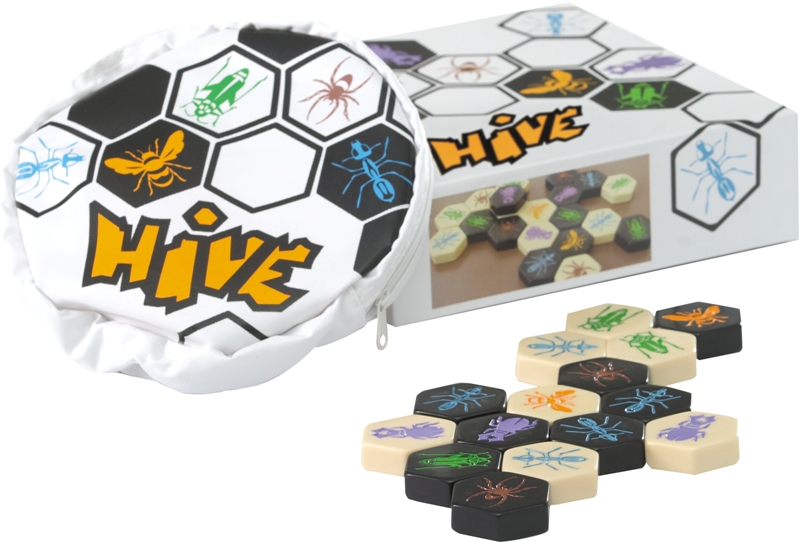 Years ago, I designed a
But as I sat down with a
Each player has a set of bakelite hexagonal pieces, each representing an insect. Each player sets down a piece next to each other, then take turns either laying down another piece or moving an existing piece. By the fourth turn, each player must put down their bee, which corresponds somewhat to the king in chess. The object of the game is to surround your opponent’s bee with pieces.
Each piece has its own style of movement. Grasshoppers can jump over any number of continuous pieces to land in an empty position, while beetles can climb on top of other pieces.
There are other rules, but you see the overall shape of the game: the hive grows as the game continues, and the pieces shift based on each player’s strategy. One has to be careful about what piece one moves. What are you leaving vulnerable, and what pieces can take advantage of your new position?
Very young children would probably have a tough time remembering how all the pieces move, but tweens should have no problem playing. Better, the game comes in a vinyl carrying case the size of a hardback book, so it’s easy to take anywhere.
Despite the simplicity of the rules, there are a lot of complexities that arise from gameplay. Because there’s no random element, beginners are at a massive disadvantage against expert players. So be nice if you’re teaching!

"Dice" by ellasdad on Flickr
I want to be a better game player, a better GM, and a better game designer.
I’m poor at playing. I just don’t get deeply into my characters, and I don’t remember the system well.
I’m a pretty effective GM, I think, but my narrations are often bland and I hesitate often. I don’t prove a smooth play experience.
I need exposure to a lot more games to have a sufficiently large toolbox of mechanics to use when designing games.
One of the best ways to improve is through experience, so I’ve set myself a challenge:
By the end of July 2012, I will play 50 games that I’ve never played before. They can be card games, board games, or
I’ll write about each game I play. RPG posts will be posted on The New Haul, while board/card game articles will be posted back on my regular blog. I hope you’ll follow me on my journey.

"Shanghai | Hazy Lujiazui — PuDong, Shanghai" by Ikiller123 on Flickr
I wrote a little while ago about a model for an RPG handled entirely via apps and software, in which all the mechanics are run by computers and the humans just see the results.
This is conceptually elegant; let computers handle the
But there are problems.
For one, the system has to have apps for many different devices. In the current market, that’s a lot of work. This means, at minimum, an iPhone app, an iPad app, and at least one Android app for each major version of Android on phones out there.
(Required caveats: Yes, I know you can develop one app for both iPhone and iPad, but you need separate UI designs for each class of device to be effective. I’m not familiar with Android development, but I understand that different phones are locked into different major versions of Android, so you can’t always have one Android app for every Android phone.)
You have to get every single player to download the apps, set them up, etc. It’s not as easy as loaning someone a book and a
If it’s a paid system, the developer has to choose effective prices, which would be harder in an unproven frontier like this than in the more
GMs can’t fudge the system, or invent their own house rules. This is a major problem for a lot of gamers; adjusting a game to one’s play style is an important part of the experience. Can a system be built that people wouldn’t houserule?
You have to trust the software. When every calculation is opaque, it’s easy to wonder how fair the software is. Or if you’ve set up your character correctly.