An All-Digital RPG System

Imagine an RPG system that’s handled completely with digital tools. Not only is your character sheet displayed on a screen, the mechanics are handled there, too.

Imagine this: a group sits around a table, each participant holding a smartphone, PDA, or tablet.

The GM touches “Moderate difficulty” on his tablet and asks Maria for a Perception test. She touches her Perception stat; it immediately rolls and flashes the result, “19,” at her. A wireless message is sent through the ether, and the GM sees “Success!” on his tablet.

Everything would run on an app. Characters could be created directly on these devices, or developed on a desktop or laptop then accessed on those devices.

How about a virtual tabletop? This is a bit harder to envision, but it’s certainly possible that a company will build and sell a tablet that’s much larger than today’s iPads. Such a thing could easily be used as a virtual tabletop, and wirelessly sync with each players’ device to automatically show markers, bloodied creatures, etc.

These digital systems would revolutionize LARPing. Just reach into your pocket and touch your smart phone to determine if you hit or miss an opponent.

(Obviously, there’d be purists; this wouldn’t kill traditional LARPing. But it could add a new experience.)

The technology is really already in place for all of this. Would it work? That’s another post.

A Personal Plea From Me To You

I’ve been reading personal improvement books lately. They’ve inspired me to pass along a recommendation that I hope you–yes, you, reader–will take to heart, think about, and implement.

Stop watching TV.

Completely.

Give your TV(s) away, if you can.

“But there’s good stuff on TV,” some proclaim. Yes, there is. There’s also good stuff in books and in movies. The problem is not the content; it’s the method of delivery.

You know all this. This sounds stupid. But this one stupid thing will suddenly give you the time to do all those things you want to do. Seriously.

Dragon Age is D&D 4.5

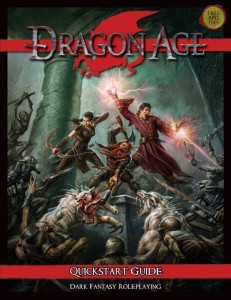
Dragon Age RPGI recently grabbed the Dragon Age Quickstart Guide, and I love this system. Haven’t played it yet, which may change my opinion of course, but I love what I see. Were I to design D&D 4.5, I’d make something very similar to Dragon Age.

For simplicity’s sake, I’m going to describe DA in comparison to D&D 4E.

Instead of rolling a d20 on tests, you roll 3d6. This gives you a lovely probability distribution curve, so you’re more likely to roll an 9 than you are to roll a 3 or an 18. This is beautiful; it makes wild success (or wild failure) less likely. Unfortunately, degree of success is not factored into the system that I can see, so that distribution curve isn’t as significant as it is in, say, FATE. But it’s better than a straight d20.

Attributes

The six basic attributes (called “abilities” in Dragon Age) are renamed, and two are added: Magic and Perception.

Each attribute/ability can be augmented with a Focus, so your Perception might have a focus of Hearing or Tracking. The Quickstart Guide doesn’t explain the rules for how many Focuses you can have.

In 4E terms, your base attribute score is gone, leaving only the modifier. So, your Dexterity will only be 3, not 17 (+3). Since 4E has rendered base attribute scores pretty much obsolete (when was the last time you needed the base number itself?), this is a wonderful simplification.

Skills are gone, replaced with abilities and Focuses. To roll a test, you use the appropriate ability’s value. Use of a Focus adds +2 to your roll. So, to listen closely to a conversation behind a door, you’d use your Perception ability. If you had a Focus of Hearing, you’d add +2 to that.

Everything is against a Target Number, single digits being easy and teens being hard.

Combat

Combat rounds are structured like 4E’s, except that there’s no Move action. Moves are integrated into Major (equivalent to Standard in D&D) and Minor actions. You can move during your Minor action, and/or run (move double your speed) during your Major action. And yes, those stack. I like this, and am curious to see how it’d work in-game. While I like the Standard/Move/Minor split, I have certainly seen players slow down combat as they try to figure out whether they’re going to “waste” a minor action.

Defense in DA is split into two numbers: Armor Rating (which works just like Armor Class in D&D), as well as a Defense (usually 0 to +4), which is subtracted from whatever damage is dealt to you. This allows for somewhat more complex defensive situations, such armor that doesn’t much Armor Rating but greatly improves your Defense (you’re just as easy to hit, but it does less damage).

Instead of targeting defenses like Fortitude, Reflex, or Will, attacks can target any attribute and Focus. This makes a lot of sense, since Fort, Ref, and Will are built off your attribute scores anyway.

Dragon Dice and Powers

One additional tweak is the dragon die. One of your three d6’s must be a different color than the others, and that will be your dragon die. When attacking, you can use the roll on your dragon die to buff your attack in different ways, via a lookup table. This strikes me as a bit fiddly; I’ll have to see how it works out in play.

In addition, your dragon die is used as a plus in certain circumstances; if you roll a successful Heal check, you add your dragon die’s roll to the number of HP gained.

Powers are a much weaker component than in 4E, at least in the Quickstart Guide. there’s no standardized format for powers, so they’re simply written out descriptively in plain text. There doesn’t appear to be any at-will/encounter/daily power break out, either.

But that’s the only drawback I see. Overall, I love the simplifications of the system, and the additions (such as the dragon die) make immediate sense.

Remains to be seen how it’ll work in-play, of course, but I love what I see.

What Do You Want Your Fights to Feel Like?

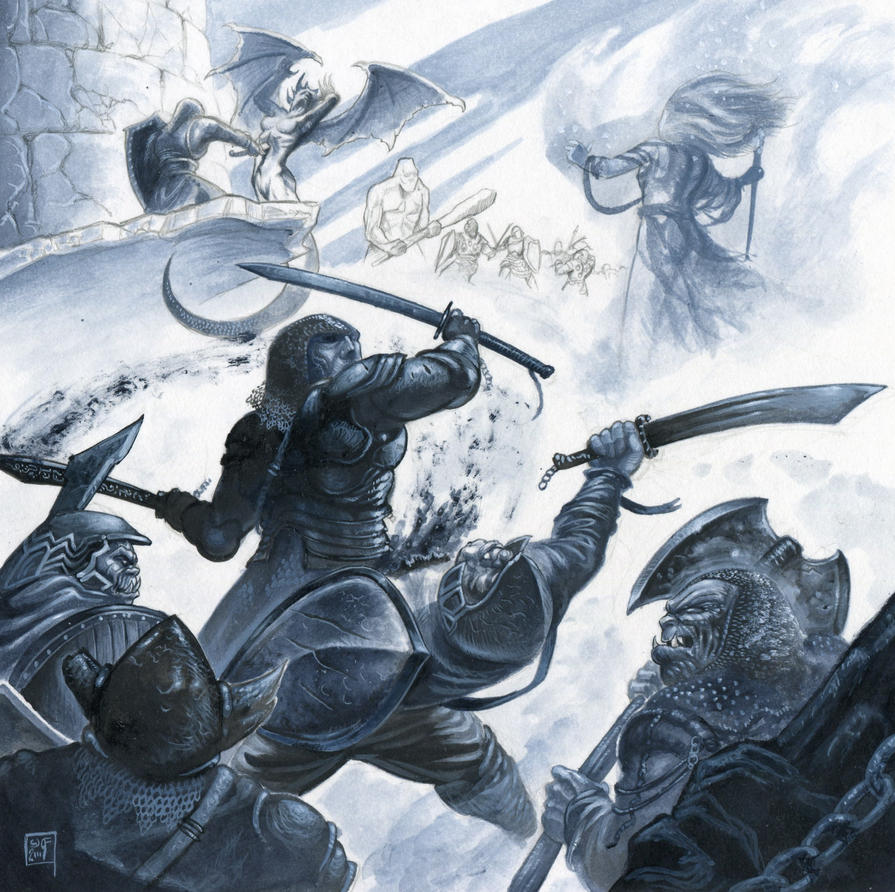
"Fantasy battle" by krukof2 on DeviantArt

"Fantasy battle" by krukof2 on DeviantArt

This applies to GMs and to designers.

For GMs: What fights do you want? Take a moment to imagine the feel of those fights. A big, roaring monster? Swarms of mooks rushing at the heroes? A cackling, insulting controller with a bunch of minions? A squad of enemies, each with its own attack patterns? Choose monsters that fit that theme.

For designers, this gets more interesting.

What sort of conflict do you want in your game? What would that look like in your world?

Will your world include a lot of subtle social conflict? Will there be monsters (e.g., non-sentient, antagonist creatures)? How dynamic will your combat be? Will your setting have a lot of easy-to-kill minions? Should combat be brief or long and complex? How deadly should physical combat be?

Not only will you benefit from designing your conflict system around these considerations, you’ll also want to design your monsters and enemies to support this.

If you want dynamic physical combat, something like D&D 4E’s powers will help a lot. If you want combat to go quickly, a status-based system might work better than HP.

It all comes down to what you want.

Castles Were Decoration

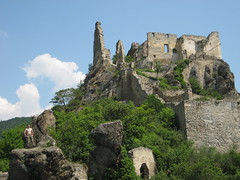
"Castle Durnstein (with YPaul)" by muppetspanker on Flickr

"Castle Durnstein (with YPaul)" by muppetspanker on Flickr

I’ve been listening to a series of lectures on historical castles, and it’s changed how I think about castles in an RPG setting.

Debate about castles rages, naturally, so take all this with a grain of salt, but:

Castles were not just fortifications. Indeed, fortification was a relatively minor element of their function. Castles were homes and symbols of power. Many of them were built to look imposing, and were actually hard to defend.

Castles became symbols of power and stability. Not only did they say “The noble is wealthy,” they said, “This noble can protect his peasants.”

Statistically, most castles were earth-and-timber affairs. Stone was just too expensive. In later centuries, many earth-and-timber castles were slowly converted section by section to stone. That conversion was, of course, messy and slow. So one might enter a “castle” that consisted of an earthen wall surrounding a stone keep.

Speaking of keeps: an important aspect of every castle was its relation to the noble who owned it. Each gate and wall was another layer keeping you from the noble, so the deeper you were allowed inside a castle, the more important you presumably were. The inner keep was a very special political place, because of what it said about anyone allowed to get inside it.

As the Middle Ages wore on, sieges grew increasingly popular, and castles became obsolete as a result of two primary practices: cannons and slash-and-burn tactics. As important as cannons were for wearing down a castle’s defenses, destroying all the surrounding property was arguably the larger problem. It does little good to lock oneself in a castle only to watch the destruction of your long-term food supply. Thus, castles became superfluous.

Implications for role-playing games:

  • If running a castle siege story line, why aren’t the besiegers destroying the surrounding countryside? What do the besiegers want out of that countryside?
  • How much food is in the castle’s stores? Many castles would keep months’ worth of food, but many others had only a few weeks’ worth. What happens when the besieged run out of food?
  • What if the castle is in the middle of conversion to stone, or partly built? How easy is it to defend? Might the castle need human protectors for its weak spots?
  • Where does the noble hold court? Where does he live and sleep? Where does he keep his valuables?

What questions would you add to this list?

D&D 4E Forces More Interesting Stories

"Death Face Vector Image" by Vectorportal on Flickr

"Death Face Vector Image" by Vectorportal on Flickr

D&D 4th Edition makes death rare. A player-character can be knocked unconscious, and one can be dying, but actual character death is generally uncommon.

Character death is a big driving force for players, and provides the primary dramatic tension. Death is always scary. For a long time, the possible death of your character (usually via poor Hit Point rolls and good monster Hit Dice rolls) created a lot of the tension in D&D–will the next monster murder my character? Will this boss crush her?

Now that 4E makes death rare, combat is less of a risk than before, and death is no longer a driving force. That means that DMs must now make the overall story more interesting.

The story itself must be dramatically interesting now. DMs can’t rely on possible death for drama.

I wonder if 4E’s designers intended this, or if it was a lucky result of incorporating player feedback that random character death in the middle of a dungeon isn’t fun.

Just thinking.

Playing D&D 4E on IRC

"The Wizard" by seanmcgrath on Flickr

"The Wizard" by seanmcgrath on Flickr

(I’m really unhappy with the way this blog post turned out. But I can’t think of a better way to write it, and I’d rather have it released than sitting in my drafts folder for months. So, here you are.)

Last night, as I waited on yet another piece of software, I looked in on the Four Winds Tavern, a freeform IRC channel gamefiend of At Will runs on his 4eAtWill.net IRC server. Folks were conversing, and I asked if they’d be interested in my running a quick story. They agreed.

We proceeded to play D&D 4E for an hour in an IRC chatroom.

I’m fully aware that this should be insane. This is about as far from the ideal as you can get. And I learned a few things:

The biggest advantage came from the players, who focused on role-playing as opposed to making rolls. We rolled almost no dice until just before combat. So the story just flowed.

Time for the evergreen refrain: combat took longer than I would have liked. That said, since there were only 2 PCs, it moved quickly enough that it never felt boring. Fortunately, too, the other players had to leave after the second round.

In the future, I plan to halve any enemy’s HP and increase damage by 50%. Combat just needs to move quickly.

Once combat began, the channel filled with mostly OOC chatter. gamefiend later suggested that we open a channel purely for combat OOC discussion. This would work far better, judging from how well that worked on my Google Wave games. There’s just that much rolling in a 4E game.

The grid posed no problems; we just described where players were relative to each other, using squares mostly to calculate distance. Precise positioning will certainly be more difficult to model over IRC, but I trust that players and DMs can be as fine-grained as necessary.

Overall, I was very happy with the time we spent. I had fun, and the players wanted to play again. Success.

Hobgoblins of the Role-Playing Minds

As I mentioned a few weeks ago, I finally finished my Dark Sun adventure. I was so excited that I looked around for other half-finished adventures, and found one.

But it wasn’t half-finished. It was 99.9% finished. Literally, I just had to update some stat blocks and I was done.

So. If you’re interested in holding off a war party of hobgoblins, then tracking them to their underground lair, check out The Hobgoblins of Ravenspointe at RPGNow.com.

Huzzah for actually finishing things!

The Business of Art

"September 3rd sketch" by jon_a_ross on Flickr

"September 3rd sketch" by jon_a_ross on Flickr

I pay artists. If you’re an artist, and you’re charging money for your work, please read this post.

I love artists. But they’re often, well, frustrating to deal with. I’ve had to terminate my relationship with too many artists. Here’s how to avoid that for your clients:

Figure out what you will and won’t do. Communicate that. This is obviously important for taboos like sex or violence towards children. But it also applies to the business side of things: Will you sell art for commercial use? Can customers re-purpose your art? Re-sell it?

Make sure you communicate this to each customer, too. It’s great if these restrictions are posted somewhere on your website, but don’t assume that every customer has read them.

Figure out a schedule for your work. Communicate that. How long until the work’s complete? I don’t need a specific date that’s graven in stone; just a rough estimate in weeks.

This works even better if you can subdivide that schedule into a few deliverables: a rough sketch in two weeks, then the complete drawing two weeks after that, for example. If I have to wait three months and then all I get is the final piece, that leaves no room for resolving problems. And there are always problems.

Communicate changes. If your mother gets sick and delays your work for a week, that’s perfectly okay, as long as you tell me when it happens. If you wait until after the deadline and then tell me about delays that occurred weeks ago, that’s not okay. Let me know.

That’s it. Just figure out your boundaries and a rough schedule, and communicate often. That’s all I ask. Please.

The Tarrasque As Threat

RPG geekery to follow.

Just finished reading You Are In The Tarrasque over at Daily Encounter, and it has me thinking about how to use the Tarrasque in a game.

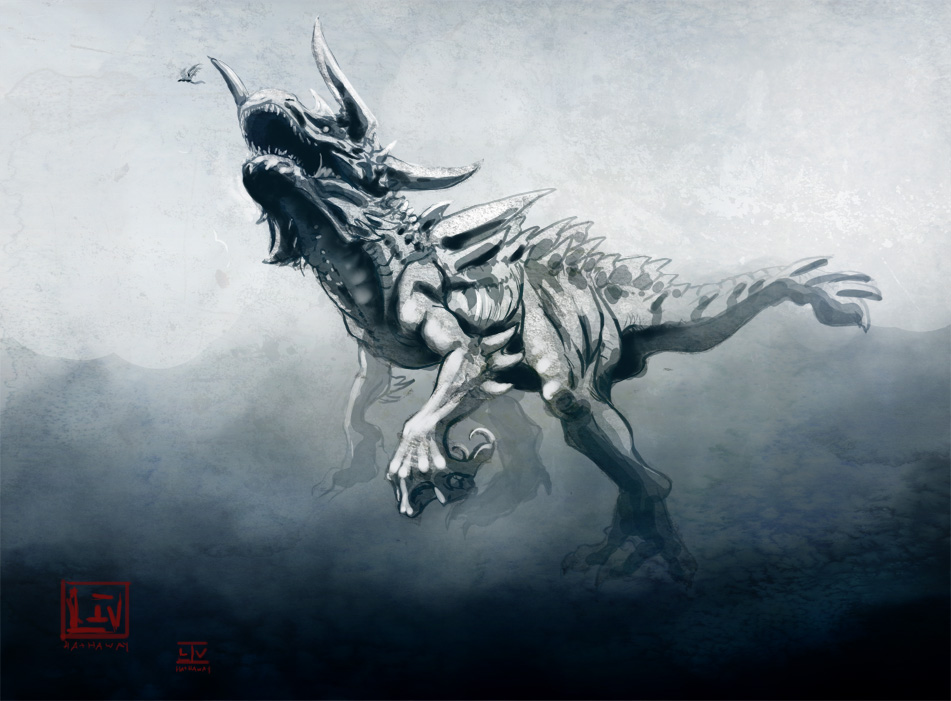
Tarrasque art

Tarrasque wip? speedpaint © Blackmane on DeviantArt

For those unfamiliar: in D&D, the Tarrasque is a massive, dinosaur-like engine of destruction that wanders the world annihilating things. Imagine a feral dragon with a stick up its butt and a hatred for the world. Its purpose is to rampage through cities, destroying them.

The danger here lies in unleashing a Tarrasque on an unsuspecting party. That’s just uninteresting.

Were I to use a Tarrasque in a game, I think it’d be a known threat. Let’s say, an evil sorcerer threatens to unleash a Tarrasque, or there’s a legend that the Tarrasque will be released if certain conditions are met.

So, the story can build up to the release of the Tarrasque.

The danger here lies in the implied assumption that the players can stop the Tarrasque’s release. To counter that, I’d add a twist:

A sorcerer has discovered that, under certain conditions, he can summon a Tarrasque that is under his control. Once the players encounter the sorcerer, he’s in the middle of the ritual. The sorcerer turns on the party. The party kills the sorcerer, or otherwise breaks his concentration and affects the ritual. While the Tarrasque does appear, it is no longer under the sorcerer’s control.

One other interesting idea: if the Tarrasque does rampage across the world, damage wide swaths of it, one could build a small campaign setting around a D&D world that’s picking up the pieces from a Tarrasque attack. There’d be tremendous amounts of work to be done, securing supply lines and rebuilding, as evil races take this opportunity to loot defenseless towns.

Much could be done.

I work for Amazon. The content on this site is my own and doesn’t necessarily represent Amazon’s position.