Suburban Self-Sufficiency: The Backyard Homestead

Cover of The Backyard Homestead

Cover of The Backyard Homestead

I may be moving soon.

My new job at NASA (squeeee!) requires a minimum 75-minute commute twice daily, usually in heavy traffic. While I’m okay with the drive itself–having grown up in this area, I have to be–I’m losing too much time. Even with audio books, three hours a day on the road is too much.

So I’ve been looking at houses near Goddard. One is a small house on 3/4 of an acre. That sounds small as I type it, but when I walked the property it felt huge.

Coincidentally, a few days ago I bought The Backyard Homestead, which purports to be a primer on self-sufficiency within a small urban or suburban plot of land.

It’s fantastic. With clear, concise language the authors describe a wide range of activities, from canning and preserving to owning chickens, goats, and cattle.

This is not a complete encyclopedia to caring for goats, of course. Instead, it’s a solid foundation in self-sufficiency. It’s a perfect balance of breadth and depth.

My, How Wired Has Fallen

My impression of the last half-dozen issues of Wired:

  • Messy, cramped layout.
  • Colors that clash and don’t add information.
  • Tons of ads. And I mean multiple consecutive pages of just ads.  Very few full pages of content.
  • Many stories have a fearmongering aspect. A good example is the article on Simon Singh, who was sued about his work on pseudoscience. This is portrayed like a Worrying Threat To Science, as though religious nutjobs haven’t been doing this for decades.
  • Lots of fluff. Snippets of trivia. Speculation based on tiny samples of data.

It’s like reading a randomly colorized Twitter feed that’s half advertisements.

Swingers

Swingers

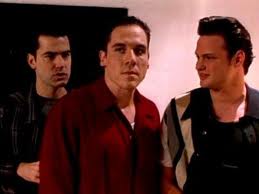
Screenshot from Swingers

Swingers has heart.

It’s clear that its main strengths lie in its script and its actors. The rest of the film fades away in comparison. Much like, say, The Big Lebowski.

The script contains more memorable lines and sequences than the vast majority of films, and it does so at the expense of a strong, driving story. This is not a complaint; Swingers is about a man caught in an awkward time in his life. It’s about his everyday choices and his everyday life; it’s about the clubs he visits at night, and the girls he walks up to.

Even better, the film has a strong moral core, as is shown by the final scene in the movie. Far from the typical amoral dating movie, Swingers has a few things to say.

You’ll probably recognize almost every cast member, and the film works mostly because of the strength of their performances. Jon Favreau based the script on his experiences with these actual actors, and they inhabit their characters perfectly.

I still remember a lot of the film, even a week later, which is a testament to its script and actors. The rest is, well, typical of a low-budget movie: it’s there to get the job done.

The job got done.

The Big Adventures of Barry Ween

Barry Ween

© Judd Winick

A recommendation from the three guys at iFanboy means a lot to me. They know how to review and recommend a comic book.

So on a whim, and after a stratospherically high recommendation from Ron, I bought The Big Book of Barry Ween. It’s an independent comic about a boy genius and the adventures he goes on.

Thankfully, hilarity really does ensue.

Cliched set up; hilarious execution. Judd Winick’s writing is consistently funny and his plots move fast, almost too fast for Barry to keep up with.  This is essential for Barry Ween‘s premise; things have to get big for them to pose a challenge to a genius.

More importantly, the patter between Barry and his best friend Jeremy is scatological in the extreme. Normally this turns me off, but this material is so well-written and presented in such a contrast to the boys’ standard suburban life that it works.

The book’s divided into chapters, one for each adventure Barry and Jeremy get into, culminating with a big two-parter that, delightfully, gets serious. No spoilers here; suffice to say that my attention lingered for a long time on the final two pages.

Color me impressed.

Fly Me to the Moon

NASA LogoI’m several weeks into my new job at NASA. I’m elated and frightened.

I’m experiencing a new employee’s stress. Besides learning the location of the kitchen, and when the trash is collected, I’m incredibly scared of screwing up. Of missing some vital assignment or suggesting the wrong thing or telling the wrong joke. So much shared culture has built up here, and I’m afraid of suggesting the taboo topic, the subject that will forever tarnish my reputation.

Of course, there’s absolutely no evidence of this. My co-workers have been universally kind, understanding, and explanatory. In fact, if this were a place where an ignorant suggestion would forever tarnish my reputation, I wouldn’t want to work here.

But I do want to work here. Badly. I want to spend the next 20 or 30 years of my career here.

Plus, I’m now beginning to receive real work assignments, serious responsibility. I don’t want to screw this up.

No, it’s  more than that: I want to succeed brilliantly. I don’t want to do okay; I want to do great things here. I want to bring NASA big successes.

Without offending anyone or screwing up.

Taxi Driver is a Superhero Movie

Here’s the plot of a movie:

A regular guy grows increasingly frustrated by the crime and evil that surrounds him on the streets of New York. So he gains the power to fight back, then sees a young girl in trouble and saves her from the men who’ve kidnapped and drugged her for money.

That’s the plot of Taxi Driver.

Three things intrigued me most while watching this film for the first time last week:

1) I thought Taxi Driver was about Travis Bickle’s rise and fall. That’s not accurate. It’s about Travis’s increasing disgust with the depravity around him. It’s about a man who just can’t take it any more. He wants to be a hero. He’s capable of evil, certainly–he nearly shoots a politician just for being a politician (okay, it’s more complicated than that, but still)–but it’s because he cares about people. Every one of Travis’s violent acts results from Travis seeing someone suffer, and his desire to end that suffering.

2) This is one of those films that has everybody in it. I recognized most of the faces.

3) If you want to know why people consider the 1970’s the Nadir of Western Civilization, Taxi Driver provides all the evidence you need. Now, yes, the film intentionally focuses on the worst parts of 1970’s New York City, but from what I’ve seen and read and heard from those who lived it, Taxi Driver is accurate. No wonder post-apocalyptic films took off; no wonder kids inhaled comic books. The apocalypse seemed like the only logical conclusion to the decay, and the only logical escape was into a fantasy world of spandex-clad superheroes who could stop a nuclear bomb by pointing a magical ring at it.

In such a dark world, heroism became twisted. Twisted into forms like Travis Bickle.

David Foster Wallace: Maddening Genius

A Supposedly Fun Thing I'll Never Do Again cover

Cover of "A Supposedly Fun Thing I'll Never Do Again"

I recently finished reading David Foster Wallace’s A Supposedly Fun Thing I’ll Never Do Again, a collection of his magazine essays. Wallace himself is a recently-deceased literary darling, author of Infinite Jest and a number of short pieces.

And now I have a problem. Wallace was a writer of rare genius, thoroughly engaging the reader with energetic prose that was often both familiar and bizarre, a conversational patter riddled with invented words.

Yet as I read A Supposedly Fun Thing…, I was tempted to throw it across the room a few times. His essay on television, “E Unibus Pluram: Television and U.S. Fiction,” includes maddening lapses in logic, and his essays on a state fair and cruise ships betray obvious elitism.

And yet again, I don’t want to disrespect the dead. Sure, the man’s writing had flaws, but who doesn’t?

Perhaps I’m jealous, of his success and his skill as a writer. I breezed through the first  hundred of Infinite Jest‘s thousand pages on the strength of his writing alone. (Not much else happens in that stretch of that novel.)

Perhaps it’s just my engineer-trained brain. Errors leap out at me. Problems flash like neon hotel signs.

The issue shines most glaringly in “E Unibus Pluram: Television and U.S. Fiction,” wherein Wallace establishes that television advertising calls on its viewers to break away from a group. His prime example is a famous Pepsi ad, in which a group of hot beach-goers see a Pepsi truck and run over to it, en masse. Wallace points out that this is simply group behavior. Agreed.

This is the odd thing: He uses this to establish that TV ads claim to be promoting individualism, of breaking away from a group to be an individual. But Pepsi’s own slogan during this period is a perfect illustration of his mistake: Pepsi was the choice of a new generation. Pepsi–along with most advertisers–promote breaking away from one group to be part of another group.

McDonald’s ads show a harried mother taking a break (which she deserves today) at McDonald’s–a full McDonald’s. When did you last see a breakfast cereal ad with only one kid?

I gave the rest of the article only half my attention as Wallace continued repeating and building on this fallacy. Perhaps this is my failing; perhaps I  should have given it up. But no; he built his argument on a fallacy, so why should I give it full credence?

The other essays are similarly flawed; Wallace weaves taut, evocative sentences to look down on fair-goers and cruise-takers. He’s clearly trying to be funny, mentioning the clichés and foibles of these particular genii of Americans, and while he sometimes succeeds he’s as often judgmental. It’s as though going on a cruise reveals a flaw of character or intellect (unless, of course, your ticket is paid for by Harper’s).

Moreover, his style is often conversational to the point of tired cuteness. He starts sentences with phrases like “And but so the thing is,” which is refreshing the first few times I read it but quickly becomes a mannerism, an empty phrasing that tries to endear itself to the reader without otherwise adding value. I don’t want to be endeared to a writer; if I ever am, it’s because of the author’s content, not the author’s mannerisms.

And here I am, spending most of this post on Wallace’s flaws, rather than the beauty and genius of his language, or his immense bravery in recording his unvarnished thoughts. I read A Supposedly Fun Thing… voraciously, in a few sittings. The essays contained in this volume are perfect examples of the essayist’s art, flaws and all.

Technological Manic Depression

"wallpaper — The ISLAND" by balt-arts on Flickr

"wallpaper — The ISLAND" by balt-arts on Flickr

Some days, I seek hyper-technology. I want to engage folks on Twitter, post on my blogs, and clean up every broken link on my websites. The online world feels so vibrant and interesting.

On other days, I want to give up everything more advanced than a clock/radio. I want to sit down with a big stack of books and a hot mug of tea, or throw wide my kitchen cabinet doors and fire up the stove. The online world feels so shallow and pointless.

I don’t know why this is. Perhaps, in my passion, I spend too much time in one world, overdosing on its pleasures.

In any event, I’ve learned to take advantage of both moods. When I’m diving into cyberspace–and wouldn’t it be wonderful if the experience really did mirror early science fiction portrayals of descent into a neon wonderland?–I write blog posts and clean up my sites. During down times, I let that content dribble out.

This has been easiest with Otaku, No Video. When excited, I record lots of videos, then I release them on a strict schedule. I usually have between one and two weeks’ worth of videos completely finished sitting on my hard drive, ready to be released on schedule.

Some days, I wish I could be less extreme in my approach. Nevertheless, it works.

Can’t Get Technoooo Satis-fack-shuuuuun

"Dicken's Village at Night" by kevindooley on Flickr

"Dicken's Village at Night" by kevindooley on Flickr

I’ve been dissatisfied with my blog for weeks now.

During one of my long IM conversations (does anyone else have IM conversations any more?) with Saalon a couple weeks ago, I complained that blogs assume uniformity of content. That each entry will need to be formatted the same way.

I also dislike the constant draw of a blog, the siren song that says, “You should be posting every day.” That’s probably just an outcome of by my addiction to the internet.

(I don’t think I’m literally addicted to the internet, but I do spend hours of my time on the ‘net every day, which troubles me when I stop to think about it.)

In any event, my uniformity argument is complete hogwash. (By the way, what is hogwash?) It’s nearly trivial to re-format different blog posts for different needs, to give a recipe a brown background with white text set in Bookman Old Style.

What I really was rebelling against was a completely linear blog, a simple chronological list of entries (plus categories, but that’s a vestigial organizational organ). As clean and simple as that structure is, my many, varied brain dumps need more than one axis of organization.

This implies an interface, and aye, there’s the rub. For a couple of weeks I’ve hacked away at a completely different, monthly blog with extremely tight, specialized design unique to each article. Unfortunately, that turned out to be an insurmountable amount of work, especially if I wanted to integrate comments and RSS.

So. If I want to organize my posts and display them the way I want to, I’ll need a highly customized WordPress theme. Which I’ll build myself, since I don’t want to spend money on something I can learn to do.

So, I’ll be changing this website as I learn. Hopefully, it’ll be able to handle a wider variety of content, in a way that is appropriate to each type of content.

Why am I going through all this effort? Because I want a really cool website.

I don’t suppose there needs to be a better reason, does there?

New Job Update

I love my new job. I love love love my new job.

I’m working with nice, friendly people, on interesting stuff. I review software that NASA’s developed to determine how it could be used by industry. How cool is that?

And my quarterly allergy/asthma/something attack has mostly cleared up; now I just walk around with a throat full of phlegm.

‘Twas frustrating to spend my first few days at work sick. Had to look my best while feeling that I just wanted to go back to bed.

On the other hand, there are far worse things.

I work for Amazon. The content on this site is my own and doesn’t necessarily represent Amazon’s position.