Urp

I start a new job at the Goddard Space Flight Center tomorrow, working for NASA.

I’m so nervous I’ve become physically ill. It began with lack of appetite and progressed to an upset stomach earlier this evening. Now my throat’s scratchy and I can’t sleep.  If I didn’t know better, I’d say I have a bug.

That’s the price I have to pay to move forward in my life, I guess. It’s rarely comfortable.

The Hyper-Local Challenge

Thought Experiment: Could I get to the point where 100% of the food I eat for myself is made from local ingredients?

It’s an interesting thought. Let’s establish a few parameters:

  1. “Local” means within 100 miles.
  2. This doesn’t count social meals; going out with co-workers for drinks or taking friends or family out to a restaurant.
  3. I wouldn’t force this on my hosts if a guest at someone eles’s house, nor would I force it on my own guests.

First question: How about local restaurants? I can’t be sure that their ingredients are local. So that’s out.

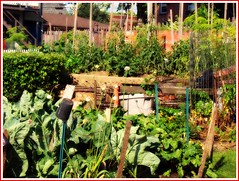
"Summer Vegetable Garden" by di_the_huntress on Flickr

"Summer Vegetable Garden" by di_the_huntress on Flickr

So. Let’s stroll through my fridge, freezer, and cabinets, and see how big of a challenge thus would be.

  • Dairy — I already get my dairy from a local farm.
  • Meat — Ditto.
  • Vegetables — I could freeze and can vegetables in the growing season.
  • Fruit — Ditto.
  • Condiments — Well, Heinz didn’t invent ketchup. I could always make my own; that’s how housewives did it 100 years ago.
  • Flour and cornmeal — There are actually local mills that mill flour, though I’d have to get a lot at once (2 to 5 pounds).  That’s not unreasonable.
  • Sugar — Fortunately, sugar can be substituted with honey in most recipes.
  • Beans — Grow my own, or buy local varieties. Fortunately, I don’t eat a lot of beans, so this wouldn’t be a huge burden.
  • Nuts — I do know of several local nut farms.
  • Rice — Okay, this just can’t be done. So, I suppose, I just wouldn’t eat rice at home.
  • Salt, pepper, and other spices — Also impossible.
  • Flavored extracts

What about other ingredients that simply can’t be grown locally, like coconut and pineapple? For the purposes of this experiment, and for now, they’re banned from consumption.

How do I eat in the winter, when no food is grown? Same as my ancestors: can food during the growing season, or use easily-preserved foods like dried beans. Plus, thanks to my local dairy, I can have meat and dairy in any season.

I could actually get pretty close to my 100% goal, if I wanted to. I don’t, yet.  But now that I’ve worked the numbers, a part of my brain is pointing out how healthy this would be.

Hmmmm.

Homemade

I’ve been eating a lot of Domino’s pizza lately.

I’ve been busy, watching a lot of movies and TV shows, reading, and writing. I realized that I need to focus on chewing through all that material, so I simply don’t have time to make meals from scratch.

But I want to. More importantly, my stomach wants to. Processed foods typically upset my stomach, like drunk tourists messing up the place.

Once I’ve finished enough of my piles, I’ll get back to serious cooking. Meanwhile, I won’t feel 100%.

Life’s not simple.

Soups

My Mom was never much of a soup person.

She’s always liked soups, but in the same way that people like cocktail peanuts or turf grass. When I think of my Mom’s cooking, I remember her chicken cordon bleu, her strawberry whipped cream cake, her divine chocolate fudge cake, her crusty French bread, her unimaginably soft homemade pasta. I don’t remember any soups. I’m sure she made some, but none glued themselves into my memory.

I’ve never loved soups in the same way that, say, the French seem to obsess over them. Soup’s always operated like a cream sauce for me — tasty, in its own way, but never a main dish.

Then I read Molly Wizenberg‘s A Homemade Life, in which she makes a strong case for soups. In particular, soup for lunch. Suddenly, soups make sense.

I always have a tough time with lunch at work. Offices never seem equipped to properly reheat leftovers, and I find myself eating like a hobo out of a sagging plastic tub. Plus, so many things really shouldn’t reheat at the same temperature; I want my roast beef hot, not the bread and lettuce as well.

(Sure, I could separate them, but then I become That Guy, the one who spends twenty minutes assembling his leftovers.)

Soups, though, are perfect for leftovers. Pop them in a big container, bring it to work along with a bowl and spoon, and you’re good to go. Bring a bag full of sliced homemade bread, and lunch becomes a meal.

Now my problem lies in finding a good soup to make. I’ve picked three tomatoes from my garden, so I’m contemplating a tomato soup. Unfortunately, I’ve never liked tomato soup. But maybe that’s because of my upbringing. No offense to my amazing cook of a Mom, but I think I need to get over my soup complex, and learn to love soup.

My Dad loves clam chowder, but that’s another story.
A Fanboy of iFanboy

iFanboyI first stumbled on iFanboy when I bought my Roku a few months back. I was skimming through Revision3’s offerings, saw a show on American comics, and watched an episode.

I found a show that combines intelligence, experience, and passion. These guys know their comics, they know how to talk about comics in a way that’s helpful for any reader, and they know the limits of their knowledge. They understand that passion can be a highly personal, subjective thing, but that it’s usually indicative of some worth in a work somewhere (the passion grew from something worthwhile). And mining for the passion’s cause reveals useful information about the work.

iFanboy is run by three comic book guys, and one thing I appreciate is the specific attention they provide to each of their productions:

The blog contains miscellaneous posts about recent comic book issues and trade paperbacks, conventions, comic book movies, etc. It’s a great central resource for comic book news and reviews.

The audio podcast is an hour-long weekly show where all three hosts talk about the comics they’ve read that week (mostly new stuff). This is a fantastic window into the current zeitgeist of American comics.

The video podcast shuffles between three formats: interviews with comic writers and artists, individual segments by each host about some interesting series or work, and a sit-down with all three. This last format I like the most. One episode looked back at the Marvel Civil War, analyzing its purpose, high and low points, reception, impact, and the question of whether it achieved its goal. Another talked about Iron Man — his origin, major stories and themes, interesting characters, etc.

I’ve modeled a lot of Otaku, No Video off of iFanboy, as much as I can. It just works.

The iPad, Revisited

iPadWhen the iPad was first released, early adopters rushed to post their initial impressions.

Now that I’ve been using an iPad for a few months, I think it’s important to come back and provide some more experienced impressions.

Here are the apps I use:

  • Daily
    • WSJ (Wall Street Journal). I even bought the subscription, so I don’t have to lug my Kindle around with me.
    • GoodReader, a fantastic PDF viewer that can wirelessly transfer PDFs from my laptop with no extra software.
    • EverNote, a note-taking app that backs up all content to internet servers. This is the centerpiece of my Getting Things Done implementation.
  • A few times a week
    • TweetDeck, a Twitter client
    • Kindle
    • xkcd, an online comic with a solid app
    • FeedlerRSS, a front-end for Google Reader, in which I read all the blogs I’ve subscribed to
    • WeatherBug, a slick weather app
    • Safari
  • Occasionally
    • X-Comics, a comic book reader and store, which sells single issues of comics for US $1 to $2.
    • Mail

don’t use the iPod functionality. That’s what my iPod is for, and I don’t want to fill the iPad with music when I could use that storage space for apps and data.

The iPad has replaced my Kindle. I still love the Kindle, but the iPad replaces all of its functions for day-to-day use. I’d prefer a Kindle in other situations, like travel (the Kindle has a longer battery life and its cellphone modem for downloading books costs nothing, depending on where in the world you are).

I encountered the dreaded “Re-enter your password” bug, in which the iPad would periodically lose its wireless internet connection and forget the password. I tried a number of different solutions, to no effect. I ended up removing password protection on my wireless network to solve it.

Nevertheless, I still use my iPad every day. After the first few weeks, my usage dropped drastically, and I barely picked it up for about a month. I then got back into it, especially when I started using GoodReader and the WSJ app. The iPad has turned into a practical device for me.

Check Out My Game

Check in on my Google Wave RPG game, The Legacy of the Lines, a D&D 4E game:
[wave id=”googlewave.com! w+Ov21ogmKA”]

Feedback

"Circle of Fire" by stephenccwu on Flickr

"Circle of Fire" by stephenccwu on Flickr

I’ve been thinking lately about the best way to give feedback to players in my role-playing games.

By “feedback,” I mean pointing out particularly effective and particularly ineffective behavior, like creative problem-solving, forgetting to update a marker, effective teamwork, or aggressive interpersonal behavior.

I used to essentially ignore this. I’d occasionally reward a creative solution with a quick “Great thinking!” I essentially ignored bad behavior.

This, of course, is ineffective.

I then picked up a feedback system from Manager Tools, which used a four-part framework:

  1. Privately, ask if it’s okay to give some feedback.
  2. Describe the behavior you’re addressing.
  3. Describe the positive or negative consequences of that behavior.
  4. Ask if they can do it differently next time.

This model’s intended for managers talking to their staff.  Role-playing’s a game; GMs take on a very different role than that of a corporate manager.  (Though there are many parallels.)

I’ve modified it to this:

  1. Privately, tell the person that I have some quick feedback.  For positive feedback, I usually start with a “Thanks” sentence.
  2. Describe the behavior.
  3. Describe the positive or negative consequences of the behavior.
  4. Reassure that this is just a little note.

It still doesn’t feel quite right. On the one hand, it feels rather apologetic — can a player really not receive feedback unless it’s sandwiched between such deprecating phrases? On the other hand, RPGs are games, after all, and the GM has little power over the players. Sure, the GM can kill a player’s character…and then the player may never come back.

I also struggle to identify opportunities for positive feedback. I suspect that skill will develop over time, but it’s hard to find things to reward when the game’s going along fine.

I suppose smooth sailing, itself, deserves praise. Hmmm.

Dhoom Machale!

Screenshot from "Dhoom 2"

Screenshot from "Dhoom 2"

I’m having a difficult time figuring out how to describe Dhoom 2. I have such a disparate readership that I feel I’m constantly explaining or defending my hobbies and interests. If I want to describe a Hong Kong action flick or amazing anime series, I feel a need to lay the groundwork necessary for a non-fan to understand what I’m talking about.

Applying standard Western movie values to Chinese, Japanese, Korean, or Indian films results in a fractured lens. Foreign cinema values different things.

So. Rather than defend or apologize for it, I’m just going to describe Dhoom 2.

It’s a Bollywood special effects cop film. It’s got shootouts, intense stand-offs, copious explosions, gorgeous actors, and modern musical sequences.

The filmmakers shot the action sequences as over-the-top orgies of stunts, gunfire, and explosions. It’s not realistic; it’s Mission Impossible without quite as much budget.

Dhoom 2 poster

The musical numbers exist as all good musical numbers should: to reveal character and/or be visually spectacular. The opening credits sequence features the villain singing and dancing to a Stomp-like, nearly synthpop piece of music, surrounded by urban dancers. It’s a music video.

The acting is common for Asian cinema; some over-the-top performances and some subtle performances, usually not from where you’d expect.

And my love for Dhoom 2 lies right there. Two scenes. One involves playful dialogue between a man and a woman on a basketball court in the rain. Subtle one-upmanship. Charismatic acting.

The other involves the same characters, with a gun between them. Guns appear throughout the film; a lot of bullets fly.  But when it’s pulled out for this scene, the gun has immediate weight and terror. This is a killing machine. And its entrance into the scene begins a wonderfully, horrifically intense sequence.

When I finished watching Dhoom 2, I gave it five stars on NetFlix.

The Goblins of Summerkeep

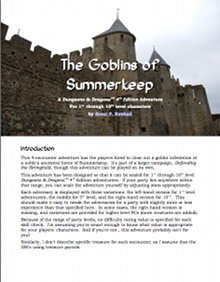
The Goblins of Summerkeep coverLast week, I finally finished and published a D&D 4E adventure, The Goblins of Summerkeep, to DriveThruRPG.com.

It took a while.  There are all sorts of little finishing steps, such as checking for errors, verifying that the generated PDF looks good, uploading to DriveThruRPG, etc.

I’m also working to make it available in multiple formats, and that’s a classic time suck. DriveThruRPG provides a print-on-demand service, but that requires its own PDFs. SmashWords will publish my adventure to the Kindle, Nook, and iPad, but it requires a specially-formatted MS Word file.

None of this is hard; it just consumes time.

It’s also the first of several adventures designed as an interlocking storyline.  Each adventure can be played separately, or strung together into a central story for a Heroic Tier campaign.  Lots of other stories can branch off of these adventures, as well.  So I’ve got plenty more work ahead of me.

It’s exhausting and exhilarating. I’m moving forward.

I work for Amazon. The content on this site is my own and doesn’t necessarily represent Amazon’s position.