Updating your WordPress Blog from WP 2.x to 3.0

"Stairs" by moyogo on Flickr

"Stairs" by moyogo on Flickr

I’ve successfully migrated two WordPress 2.9 blogs to WordPress 3.0.  No issues.  Here are steps to follow to do so safely:

Phase 1: Backup

  1. Click on Tools > Export.  The “Export” page is displayed.
  2. Click the Download Export File button.  A “Save as” dialog is displayed.  Save the file on your desktop.
  3. Click on Dashboard.  Note the version of WordPress that you are running.  The version number is near the bottom of the “Right Now” box.

Note that this will not backup plugins or themes.  For a more complete backup, also FTP to your webhost and download everything in your blog’s folder.

Phase 2: Upgrade

  1. Click the Please update now link that’s at the top of all your WordPress admin pages.  Alternatively, go to your dashboard, and click the Update to 3.0 button that’s displayed in the “Right Now” box.  The “Upgrade WordPress” page is displayed.
  2. Click the Upgrade Automatically button.
  3. Wait a few moments, until the text “Upgrade completed successfully” is displayed on the page.

You’re done!  Click around to make sure everything works okay.  View your blog to ensure that it still displays properly.

Phase 3: If Everything Goes Pear-Shaped

If your blog is somehow borked as a result of this:

  1. Re-install a 2.x version of WordPress.
  2. Log in to your blog.
  3. Click Tools > Import.  The “Import” page is displayed.
  4. Click the WordPress item near the bottom of the “Import” page.
  5. Click the Browse… button.  An “Open” dialog is displayed.  Select the file that you saved in phase 1, and click the Open button.  The “Open” dialog disappears.
  6. Click the Upload file and import button.  All the content in the backup file should be imported back into your blog.

If you followed the FTP step in phase 1, navigate to the files you downloaded, and copy everything in the plugins/ folder to the plugins/ folder in your WordPress installation.  Do the same thing with your themes/ folder.

Snap

I just bit into a green bean, picked fresh from the box out back.

I am 10 years old. I’m shucking corn on the tiny deck outside my parents’ kitchen. Errant strands of corn silk float lazily through the air to hang on the azalea bushes below. Inside, we have chicken cordon bleu with big, yellow ears of corn and green beans. Slabs of butter slide, kernel by kernel, down the corn to collapse, exhausted, on the clean white plate.

We devour the meal. Afterwards, Mom strides out of the kitchen holding a chocolate cake. The cicadas sing. This is summer.

Visual Novels

As part of a Top Secret Project, I bought and have been playing several Japanese visual novels lately.

(For those unfamiliar: a visual novel is something like a graphic adventure. The canonical example is a high school dating simulation, where the player talks with several girls in his class over the course of a few weeks, and whomever he spends the most time on becomes his girlfriend at the end. This is usually accompanied by a few scenes of the protagonist and the girlfriend having sex, to satisfy the [typically male] player’s prurient interests.)

Tokimeki Check In

© Crowd

I’ve read that visual novels have evolved from thinly-veiled opportunities to see cute anime girls naked into full-scale stories of blossoming young love. Based on my experience, it’s true. There’s been very little erotic content in any of the games I’ve played (thus far).

Tokimeki Check-In, for example, is a classic dating sim, so the characters have that 1980’s anime feel. The protagonist runs a mixed-gender hot springs spa, so there are various opportunities to accidentally see girls naked. As a result, it’s a less interesting game than the others, as the point of the game is, erm, rather obvious.

Snow Sakura

© G-Collections

Snow Sakura, on the other hand, is a modern dating sim, where the protagonist has moved to Hokkaido (the north-most island of Japan), and is shivering through his first winter there. He’s surrounded by cute, odd girls. While it’s more of a traditional romance, the girls’ stories are revealed slowly, and the player gets plenty of time to appreciate each girl’s unique personality.

That’s one of the things I really appreciate about these games–it’s not just a few goofy scenes of high school life followed by sex with a girl.  You spend some time with each girl establishing what you like about them, and genuinely falling in love with them.

Moreover, Snow Sakura is much more of a comedy. It’s genuinely funny.

Yo-jin-bo screenshot

© Two-Five

Yo-jin-bo tells the story of a modern girl transported to Edo-era Japan. It’s a reverse harem series (a girl surrounded by cute guys), but more importantly, it appears to have the most intricate story of this set. The player has very little to do; even the limited, multiple-choice questions are few and far between.  Moreover, this is a strictly PG-rated game. As a result, the show concentrates more on personalities and story than anything else.

Overall, I’m impressed.  There are some genuinely good games out there.

Five Awesome RPG Systems You Should Check Out

Dice illusionRole-players tend to find their “favorite system” and stick with it. While they’re more open-minded about other systems than, say, programmers are about languages, they often avoid new systems in favor of the familiar.

So, here are 5 role-playing systems that are worth checking out:

Fudge

Technically, Fudge is a toolkit for making a system. The basics are brilliantly simple:

Every character’s attributes, skills, abilities, etc.–whatever you want to call them–are represented on a simple linear scale, from Terrible through Average to Superb.  Each step on this scale has a number (-4 to +4) and a term (Poor, Fair, Good, etc.).

To swing on a rope over a burning building to safety, you choose your character’s most relevant attribute–in this case, Acrobatics or Athletics or Dexterity or whatever–and you roll Fudge Dice.  These are four dice, painted with sides containing +1, -1, and 0.  Let’s say I rolled +1, -1, +1, 0.  That’s a total of +1. Take the results and add them to the attribute’s value, and that tells you how well (or poorly) you succeeded at the action.  That’s it.

So, if I’m Good (+2) at Acrobatics, and I roll my Fudge Dice and get +1, I was Great (+3) at swinging over the burning building.

FATE

FATE takes Fudge and adds a literary hero vibe.  Characters are created by dividing the character’s past into several major eras (childhood, young adulthood, the War Years, etc.), and for each era, defines one major Aspect that defined the character during that period (working as a bounty hunter, association with the Black Hand, learning to hack, studying at the Temple of Pages) and the skills learned during that period.

Characters also have Fate Points, which they can use to change fate.  This ties in beautifully with Aspects–the GM can bid to use one of your character’s Aspects to get the group in trouble (for example, your Expert Gambler aspect tempts you to wager everything on a game of cards). You can spend a Fate Point to resist this twist of fate, or allow it to happen and receive an extra Fate Point.  Fate Points can also be redeemed to essentially guarantee success on dice rolls.

This explicitly encourages flawed characters. The more flaws you have, the more Fate Points you build up, which allows you to succeed wildly when it counts.

Houses of the Blooded

An indie game of political intrigue. In a sense, this is more of a setting than a system. You play one of the Blooded, a race of magically and genetically modified humans who now rule humanity (some benevolently, others less so) in a pre-historical feudal age.

Its creator, John Wick, describes Houses of the Blooded as a reaction to D&D.  Well, I’ll just quote him:

Almost everything that’s true about D&D is untrue in this game. In D&D, the most common kind of character is a wandering nomad who lives outside the law, an adventurer roaming the countryside, killing monsters, gaining treasure and weapons so he can kill bigger monsters….

In Houses, you play a noble. A character with a past. A character with a family, with vassals, responsibilities and duties. The Law is an ever-present factor in your life….”Treasure” really has no value for you and problems such as “wandering monsters” are problems for someone of lesser status to handle….And rather than living in a bubble immune to the effects of political scheming, your character lives in a world that looks like a bastard child of Tanith Lee and Niccolò Machiavelli.

But this is not a game of drawn-out conversations. Your character actively pursues goals. But those goals are far more complex than clearing bugbears from a town.

Dread

I’ve run this game several times, and it’s always been a blast.  I think I’ve blogged about it before, but I’m going to blog about it again.  It’s that effective.

It’s a game of one shots and high body counts.  Only one character survives the session (sometimes not even one).

Character creation involves answering a series of invasive questions, such as, “Why do you keep carrying that thing in your pocket?” and “Why does your father hate you?”  Each questionnaire is specific to that player.

The mechanic is a Jenga® tower. Really. Every time a character attempts some difficult action, the player must make a pull from the Jenga tower, according to standard Jenga rules. A very difficult action requires two pulls.

If a player knocks over the tower, that player’s character dies. If a player intentionally knocks over the tower, that player’s character succeeds at whatever he or she is trying to do…then dies.

When the tower’s rebuilt, the GM makes three pulls for each dead character.

Here’s the genius: it takes an hour or two before the first death. But the next death comes more quickly. So the longer you survive, the greater the danger.

It’s an impressively tense game, ideal for survival horror.

Primetime Adventures

This is a simulation of a TV show, particularly a drama. If you want to play Buffy: The Vampire Slayer, The O.C., or E.R., this is the system.

It centers on the idea of drama. Each player is a character in the drama (except for one player, the Producer), and the drama is divided up into episodes and scenes. The system determines which characters have most “face time” during each scene, and the players collaboratively decide what happens during that scene. Compared to a traditional RPG, there’s far less random chance and far more discussion about what would be the most interesting plot twists.

As a result, Primetime Adventures doesn’t play like a traditional RPG. You’re building a series of TV episodes, really. It’s more abstract than a D&D game; you don’t hear the screams of combat or feel the hilt of your sword; you think about drama and suspense.

If nothing else, it broadens your mind.

Hope this helps!  Do you have any favorite systems you’d recommend? Let me know in the comments!

Professional Asperger’s

I’ve worked with quite a few folks who exhibit what I’ll call Professional Asperger’s.  See if this sounds familiar:

  • You stop by their office to ask a question. They look up with their lips pursed, give you a one-word answer, then return their attention to their computer. Consistently.
  • In a meeting, a co-worker admits to making a mistake. This person literally boggles, and with a clipped tone reprimands the co-worker.
  • A user complains about the workings of a little-used part of the system.  This person complains privately that the user’s “an idiot” or “shouldn’t be using the application if they can’t figure it out.”

Note that I’m not talking about people who are quiet, or who aren’t “people persons.”  There’s a big difference between being quiet or focused, and being outright rude.

And yet…when you go out for drinks with this person, they’re nice and normal and polite.  No problems whatsoever.  They’re downright fun outside of work.

What’s going on?  Why the difference?

I think people have unrealistic expectations of the workplace.  “People should just do their jobs,” they’ll say, with the unspoken addition, “correctly, all the time.”

These people treat co-workers like machines, to an extent.  If a peer says “I think it’ll take 10 days to write this code,” then it’ll be done in 10 days.  If it takes 12, a Professional Aspie will act downright shocked.  We’ve all seen this.

But what can we do about it?  Well, we can accept that our co-workers are humans.  Mistakes will happen.  On your project. Real workplaces are not full of beautiful people wearing business suits, striding purposefully down hallways and Executing every minute of the day. We don’t pull all-nighters and solve the problem by morning; we pull all-nighters to find out why there was a problem so we can submit it for the approval process to be tested in two weeks, if that one guy doesn’t throw a monkey wrench into the situation like he usually does.

We would also do well to think more about our co-workers strengths and weaknesses.  We all love to take personality tests; when did you last apply one to your boss?  Your peers?

That’s all I can think of. What would you do?

Another Science Fiction

Another Science Fiction by Megan Prelinger

Another Science Fiction by Megan Prelinger

Megan Prelingerhas done society a great service: by publishing a book of commercial space advertisements from the 1950’s and 1960’s.

These are the great old illustrations of rockets, moon bases, and astronauts, each reproduced in full color on glossy paper in this book that would look perfect on a coffee table.

Each illustration bursts with optimism.  This was the era where we would go to the moon, we would establish bases, and we would live amongst the stars, perhaps within our lifetime. Everyone knew it was an enormous challenge, and moreover, that we would face it and overcome it.  Because, as James Lileks put it, the point is not to drop our toys on other planets.

Sample page from "Another Science Fiction"

Sample page from Prelinger's Another Science Fiction

The discrepancy between that optimism and the eventual reality forms a sadness that reverberates throughout the book.  While much of the satellite technology advertised here became important facets of our daily lives, we now live in a world that sees space as…fantastical, somehow. Impractical.

How I hate that word.

Unfortunately, Prelinger’s writing is frustratingly dry. She focuses on the facts of the corporations involved–which is useful, I suppose, but dull. The text reads like a textbook of corporate investment in space technology. The artwork consistently outshines it. Prelinger can clearly write; I just don’t understand why she confined her talent to dry corporate histories.

Fortunately, the book is well worth the price even if it only contained the artwork. It’s an inspiring look at an inspiring age.

18 Months of RPG Sales

[IMAGE]

© masochismtango on Flickr

About a year and a half ago, I published two role-playing PDFs, an adventure (War in the Deep) and a sandbox setting (The City of Talon). I’ve posted my earnings-to-date one year ago and six months ago. Here’s what I’ve earned since then:

Sales For The Past Six Months (December 2009-May 2010)

Product Number of Sales Gross Net
War in the Deep 2 $10.00 $6.50
The City of Talon 2 $10.00 $6.50
TOTAL 4 $20.00 $13.00

Sales For The Past Year (May 2009-May 2010)

Product Number of Sales Gross Net
War in the Deep 7 $35.00 $22.75
The City of Talon 7 $35.00 $22.75
TOTAL 14 $70 $45.50

I won’t bother charting the month-to-month sales, as they’ve obviously tailed off even more dramatically than six months ago.

Web Traffic

Total hits for War in the Deep on DriveThruRPG: 8,549

Unique pageviews for War in the Deep on the Musaeum in past six months: 6

Total hits for The City of Talon on DriveThruRPG: 5,389

Unique pageviews for The City of Talon on the Musaeum in past six months: 34

Source Pageviews
bluedwarf.co.uk 18
Direct 10
ENWorld.org 9
roleplayingtips.com 2
Yahoo 2
Bing 1
TOTAL 34

The keywords used to find Talon: “rpg medieval city maps” (2) and “talon city fantasy” (1)

bluedwarf.co.uk appears to be a text adventure inspired by Red Dwarf. No idea how that links back to Talon; maybe somebody linked to it on their forum?

[IMAGE]

© Laenulfean on Flickr

Advertising

None.

Marketing

I described each project here on my blog in a couple of different blog posts. I’m a member of the RPG Bloggers Network, so those posts showed up there.

Analysis

RPG adventures and settings see big initial sales, then rapidly dwindling sales over time.

Plans

I still want to publish more supplements.  I’ve been horrifically slow at publishing them, though.  I now have another setting and another adventure each at the 80% mark.

So. Need to finish those and get them published.  I’ve added them both to my list of active projects. But a plan without a date is just a dream, so:

  • By June 5 — Finish drafts of The Goblins of Winterkeep and The Pyrrean Depths and send out for review.
  • By end of June — Receive feedback on Winterkeep and Depths, and start first draft of second adventure.
  • By end of July — Incorporate feedback on Winterkeep and Depths, finish polishing them, and publish them.  Finish second draft of second adventure and send out for review.
  • By end of August — Receive feedback on second adventure, and start first draft of third adventure.

And so on.  With this schedule, I should be able to publish three supplements a year.

Em-U-Late

Context: I built a vintage video arcade cabinet about two years ago. It ran Ubuntu Linux and the MAME arcade emulator on an old off-the-shelf PC I had laying around.  About six months ago, that PC died. To be fair, it was at least a decade old.  I bought a new PC and set it up with Windows XP.
Using Windows presented several challenges, the primary one being Windows’ relative inflexibility. For example, under Linux, I had a soundtrack of classic arcade sounds running whenever the machine was on. I could configure Linux to automatically pause the soundtrack when the screen saver came on, and play when returning from the screen saver, so I wasn’t driven crazy by a 24-hour video arcade.  That’s not so simple under Windows.

Windows does have the advantage of ubiquitous support, so I could be more ambitious in other ways.

My arcade cabinet now runs about four hundred arcade, Sega Genesis, NES, Super Nintendo, Nintendo 64, ColecoVision, and SCUMM (LucasArts PC) games.  It’s all controlled from one customized interface, which lets me switch between any system.

The Emulators

MameWah is a generic, customizable front-end for any emulator application. It completely takes over the screen, and presents no standard GUI widgets.  It can be controlled using any keyboard keys you designate, and you can put in your own background images, logos, etc.

I’ve installed the following game system emulators:

  • Arcade games — MAME (standard Windows client)
  • Sega Genesis — wgens
  • NES fceux
  • Super Nintendo — zsnes
  • Nintendo 64 — Project64
  • ColecoVision — mess
  • SCUMM ScummVM

MameWah is configured using INI files; you create a new folder for each emulator within mamewah’s config folder, and drop a set of default INI files into that folder.  MameWah scans its config folder upon startup and sets itself up using the INI files in there.

The Games

The games themselves are stored as ROM files.  There are two main approaches to building one’s ROM collection:

  1. Hunt down and install just the games you want.
  2. Download a big archive of several hundred games, then find any games you want that aren’t included.  The internet being what it is, you can download collections of just about every game ever released for a system.  The disadvantages here are clutter (scrolling through lots of games you don’t want to play) and quality (some of the ROMs may be old versions, corrupted, etc.).
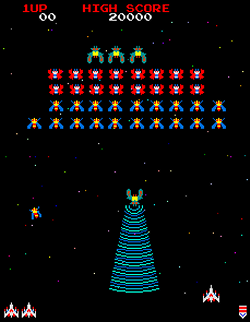
Galaga

Galaga (c) Midway

For the systems  I’m not familiar with (like the N64), I followed the latter route; I just grabbed a huge collection of games.  For the others, I consulted “best of” lists, and downloaded ROMs for the games on those lists.  Of course, I also made sure to get any games I wanted (my number one most important arcade game is Galaga).

To find ROMs, use Google. I ain’t linking to them here.  Besides, ROM sites appear and disappear like gnomes.

The Setup

I installed each of the emulators in C:\Program Files, and all of the ROMs are in C:\ROMs\[console] (so I have C:\ROMs\NES, C:\ROMS\Genesis, etc.).  I’ve also got all the original installation packages for each emulator in My Documents.

I need to back this all up, and to do so I’m going to back up each of the emulators application folders, as well as the installation packages, and the entire contents of C:\ROMs.

If I were to set it up again, I’d create an emulators folder in C:\Program Files and install each emulator within that folder, for easier backups. In fact, I may still do that before I do the backup.

To restore, I’ll restore C:\ROMs, re-install each application, then copy the backed-up application folder on top of the new installation (thus restoring all the settings stored within it).

The Hardware

This is unchanged from before: A hand-made black cabinet, with a platform holding an X-Arcade controller and trackball. The PC is a $200 desktop device, hooked up to the X-Arcade, trackball, basic speakers (mounted inside the cabinet behind several drilled holes), and a 21″ CRT screen that I got for free through Freecycle.

The Conclusion

It took me quite a few hours to get all this working. It was fun, and tiring, and occasionally frustrating. I’m very happy with it.

If you  have any questions, feel free to post in the comments.

Everybody Wave!

Last week, the Google Wave team announced that Wave is now open to everyone. It’s out of beta. Just head over to http://wave.google.com and sign in.

Google Wave screenshot

This is a good time to go over what Wave is and how I’ve been using it.

What Wave Is

Wave is a collaborative communication platform. The creators started by wondering, “What would email look like if it were created today?”

So it’s a way to communicate directly with people. You go to a website, create a conversation (a Wave), and add contacts who can see it.  The first message (blip) is automatically created. You can start typing in it, and your name, profile picture, etc. are displayed next to it.

Anyone included on the conversation can add their own blip(s), anywhere in the conversation (even into the middle of another person’s blip).  Indeed, anyone included in the Wave can edit others’ blips (and then are listed as co-authors of that blip).

Moreover, every modification to every conversation is saved, so you can “rewind” the entire conversation to any point in time.

There’s a simple but effective permission model–you can add someone and only allow them to read the conversation, for example, and you can make conversations editable by the public (or only readable by the public, or keep it completely private).

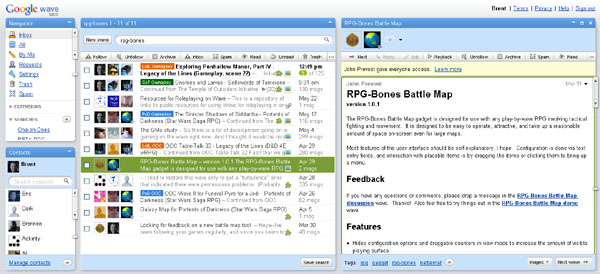
The main web-based interface to Wave shows three columns:  folders and contacts, your inbox (or the contents of a folder, if selected), and the Wave you’re currently reading.

RPG-Bones Wave extension screenshot

RPG-Bones extension

There are also a number of extensions built by Google and independent developers, which provide all sorts of useful functionality, such as a voting widget, a mapping widget, etc.  Of course, you can also attach images and files to Waves.

More importantly, this is all simple. Everything I described here can be accomplished in a click or two.  It all just works.

What I Use It For

Primarily, I run three tabletop-style RPGs on Google Wave: two Dungeons & Dragons 4th Edition games (The Legacy of the Lines and Sellswords of Tamerane) and a Star Wars: Saga Edition game (Portents of Darkness).

Here’s how I break down the Waves for each game:

  • An Index Wave, with links to all major Waves
  • A Character Wave, listing all the characters, stats, etc.
  • A Party Purse, describing all the items that the group’s carrying individually and collectively
  • A Background, describing the setup and world details
  • A Wave for each scene
  • An OOC Wave for each scene, for out-of-character chat

Once a scene comes to a reasonable stopping point — after 100–200 blips — I start a new scene.

For dice rolling, I use Random Lee Twenty, which looks for standard dice notation like “2d6+5”, calculates the result, and adds it next to the die roll (so “2d6+5” becomes “2d6+5: 11“).  For combat maps, I use the RPG-Bones extension, as that allows me to overlay a grid, add arbitrary images, zoom, etc.

It works extremely well.  I’m able to run three games simultaneously, which I check in the morning, at lunch, and in the afternoon/evening.  Each normally takes at most 10 minutes to update.

I’ve also used Wave for collaborative document review.  I or a friend create a Wave and type (or paste) some ideas.  We then add others, who add new blips in discussion, or directly fix things.  It works great.

Beautiful Nightmares

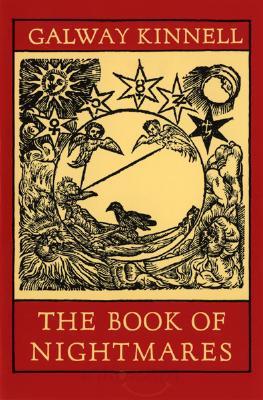
"The Book of Nightmares" by Galway Kinnell

"The Book of Nightmares" by Galway Kinnell

I love poetry, though I know very little about it. I read arguably more poetry than most during my childhood, thanks to my parents and my home-schooling, but poetry’s always been a mysterious, otherworldly thing. Not something I can analyze. Which fits poetry well, now that I think about it.

Such is the case with Galway Kinnell‘s The Book of Nightmares, which I finished reading a few days ago. It’s a themed collection of ten poems on the subjects of death and darkness (and many others, like all good poetry).

I loved it. The poems contained vivid imagery and strong emotion. That’s about all I want out of poetry.

Each poem is written from a first-person perspective and deals with dark themes: discouragement, depression, despair, fear. None of the poems offer easy answers, either; each dives deep into a set of feelings. By the end of the poem, nothing is resolved, though we are often on the other side of those feelings.

These are dense poems. Metaphor overlaps and points both backwards and forwards within each poem. While each one builds using some sort of through line, these are not stories; they are evocations of emotion, and thus harder to grasp and grok than most stories.

After finishing each poem, I felt short of breath. I even read only one poem a day, to maximize the impact of each one.

I found the experience well worth the effort.

I work for Amazon. The content on this site is my own and doesn’t necessarily represent Amazon’s position.