Veg

"Garden Tomatoes" by OakleyOriginals on Flickr

"Garden Tomatoes" by OakleyOriginals on Flickr

I was surprised recently to overhear a co-worker complain that vegetable gardens require a lot of work. Perhaps a large vegetable garden, sure, but they don’t have to be. Vegetables are plants — you put them in good soil and water them frequently, and they grow, all other things being equal.

My setup is pretty straightforward: I bought a bunch of 10-foot 2×6 boards, cut them in 6′ and 4′ sections, and constructed a 6’x4′ open-top box in my back yard, near the house. I then filled it with top-notch potting and vegetable soil.

Every year, I buy seeds from Home Depot (though I’m currently looking for more local options) and spend about 30 minutes planting them. They go in simple rows.  Being single, I don’t need hundreds of green beans, so I only put in half a dozen of each plant. My current crop includes onions, green peppers, tomatoes, green beans, eggplants, and potatoes.

Then I make sure they get plenty of water. I weed occasionally. I wonder if folks are intimidated by that word, “weed.” It conjures up images of undulating acres of crops, and back-breaking work. Not quite in this case; I just spend a couple of minutes every week or so pulling out plants that don’t belong there.  (Otherwise, they crowd out the veggies.)

That’s it. Really. No fertilizer, no hoeing, no mulch. Just harvesting the veggies once they’re ripe.

Why I started using LinkedIn again

LinkedIn logoIn Fortune article published in March, a representative of management consulting firm Accenture revealed that he expects up to 20,000 of Accenture’s new hires this year to come from social media.

20,000.

And knowing the social media landscape, when it comes to professionals using social media, you know that this doesn’t mean hiring through Facebook. The vast majority of those will come through LinkedIn, since that’s by far the most popular professional-oriented social media site.

While I created an outpost on LinkedIn years ago, I haven’t looked at it since. In light of this news, I returned to the site, and made some interesting discoveries:

  • Most of the people I’ve ever worked with are now on LinkedIn.
  • When a contact updates her profile, I’m notified, which gives me the opportunity to talk with her about the change. This is a nigh-perfect conversation starter; who wouldn’t want a message of congratulations or sympathy when their professional life changes?
  • I know a number of people who weren’t on LinkedIn, and I invited to join. Quite a few of them joined; more than I expected.  People seem to increasingly realize LinkedIn’s utility.
  • I’ve already been able to connect a contact looking for work with someone else interested. This is only a few weeks in.
  • People actually discuss topics, maturely and reasonably.
  • There are groups for about every conceivable topic.
  • Groups are plagued by spam. I don’t know why, but for every group I’ve joined, at least half of the discussion topics are individuals advertising their services (“Guaranteed marketing success for your business!”). They don’t appear to be scams, exactly; instead, they’re mildly related advertisements. I’m surprised that group moderators don’t control this.

Overall, I’m glad I’m back.

Artists Wanted

Ayukawa Madoka by "helloaby" on DevantArt

"Ayukawa Madoka" by helloaby on DeviantArt

What’s the best way to manage an artist?

I have a few top-secret projects going on right now, and they need artists. And by that I mean people who draw people and creatures.

Here’s my process for finding and working with an artist:

  1. Browse art sites. I use DeviantArt mostly, because it’s so big and includes such a wide array of artists.
  2. Send a basic proposal. There’s a delicate balancing act here. I strive to intrigue the artist, while avoiding so much detail that I overwhelm him or her. I do describe my specific art needs, in terms of how many pieces I need, whether they’ll be full-color or black-and-white, etc.
  3. Pay immediately upon receipt. Unfortunately, art is rarely completed in small, discrete pieces, so I can’t just shoot out payments every week. But when I do reach a payment milestone, I pay immediately. As in, I go straight to PayPal.
  4. Check back in weekly. We all get busy. I’ve created a reminder that comes up every Friday, reminding me to email or otherwise contact anyone I haven’t heard from in a week.

Managing my network of artists is a bigger challenge. I’ve been moving a lot of my contact management to LinkedIn, which many artists avoid (presumably because it’s “too business”).

Do you all have any advice?

Amish Friendship Bread

"Baking soda" by RowdyKittens on Flickr

"Baking soda" by RowdyKittens on Flickr

Ten days ago, a co-worker was kind enough to drop off a bag of starter for some Amish friendship bread. The starter is a light-beige mush that has to be squeezed every day, and fed with extra ingredients (milk, flour, and sugar), until the tenth day.  On the tenth day, one creates four more bags’ worth of starter and bakes two loaves of cinnamon bread with the rest.

As I’m sure you’ve figured out by now:  I made some Amish cinnamon bread yesterday.  While I have yet to try a full slice, I nibbled on the bits that fell off and it was delicious.  Full of flavor and unique personality — this is part coffee cake, part pound cake, with hints of sourdough.

And it’s friendly. It builds a small community.  As you bake, you think of more people to give it to.

Even better, imagine how nice it feels to receive a bit of starter from a friend. Even if you never use the starter.

We could use more nice things like this.

Astro Boy Made Modern

Pluto, volume 2I want to talk about craziness for a moment.

In Japan, there’s a manga creator named Naoki Urasawa.  He’s known for his complex, intricate stories that are aimed at adults.  His most famous is 20th Century Boys, a modern thriller about a middle-aged man who learns that one of his childhood friends now runs a murderous cult.

A few years ago, Naoki Urasawa contacted the son of Osamu Tezuka, Japanese cultural icon and creator of Astro Boy.  Urasawa requested the unthinkable: his own serious, adult adaptation of the most famous Astro Boy story of them all, “The Greatest Robot in History.”

To be clear, this would be something like J.J. Abrams contacting Orson Welles’ estate, requesting permission to do a Lost-style remake of Citizen Kane.  Crazy.

Tezuka’s son admitted that he would normally have dismissed the request out of hand, but Urasawa was so famous, and so famously committed to high-quality storytelling, that he felt it was important to at least meet with him about it.  And as they talked, they discovered a shared passion for the story and the concept.  Urasawa got permission.

He released an 8-volume epic, Pluto, which has won multiple prestigious awards.  It’s a serious, tense geopolitical thriller that touches on modern politics, the nature of heroism, humanity, and man’s relationship to his environment and creations.

Astro becomes a minor character as Urasawa promotes a side character in the original story to the protagonist.  Gesicht, a robot investigator, becomes the main character, as he researches a mysterious killer who’s been murdering high-profile robots.  The plot quickly expands into a global crisis and a convoluted mystery centering around a thinly-veiled version of modern-day Iraq.

Sounds crazy.  But it works.  Urasawa’s clean artwork feels cinematic, always clear but always dramatic.  You can feel the energy behind the characters’ movements.  You can feel the intensity of their concentration.  It ends poignantly and thoughtfully.

All because someone had a crazy idea, and followed up on it.

Why Who?

Doctor Who, Tom Baker

Tom Baker as Doctor Who

Decided to relax last night and watch a few episodes of classic Doctor Who.

(Yes, yes, the new Doctor Who is great. Thank you.)

Why should I watch classic Doctor Who? It’s cheesy, over-acted, and low-budget.

Watching classic Doctor Who is like reading second-tier science fiction. It may not blow your mind, but it’ll have a few memorable moments, a nice monologue, and an interesting premise or two. In addition, that will all be wrapped in a fun adventure story. Never underestimate the value of a fun adventure story.

Saalon‘s been reading Lensman, and he knows what I’m talking about. Lensman is just plain great fun.

And what’s wrong with that? I ask seriously. I feel like watching a cheesy, fun show with some good acting (at the very least, the Doctor is nearly always fascinating to observe) and an occasional deep twist needs to be defended. People turn up their noses at that, then glue themselves to the TV to watch American Idol or spend hours playing Bejeweled.

Pics and Punchlines

Just stumbled across a stunningly different photo blog — the photographer works in Japan, taking photos of everyday people and situations on the street.  The color’s always unexpected, and the subjects atypical.

Warning: Some of these photos show naked dolls, so if you don’t want to see doll breasts and butts, don’t click below:

Pics and Punchlines

A sample:

Untitled photo by Andrew Houston

Untitled photo by Andrew Houston

Wet Toes

"DSCF3811" by Walter-Wilhelm on FlickrIn a fit of curiosity and a desire to seriously research a new field of programming, tonight I downloaded the iPad SDK and built a trivial iPad app.

As expected, Apple made development relatively easy. The free development tools are comprehensive and easy to use. Also as expected, I’m still confused by all the files that go into an app. There are nibs, and Resources, and all sorts of things that simply don’t have obvious functions.

I decided to read Apple’s development guide carefully. As a coder, I’ve developed the habit of skimming the documentation, which makes sense most of the time; during normal development, I’m looking for that one fact or code snippet that will solve my current problem. But for a new field, and just generally for my benefit, I’m drinking slowly and deeply this time.

The guide is clear, concise, and helpful. It’s not quite up to the standard set by Be’s API documentation, but nothing else since has been. A close reading of Apple’s guide told me the vast majority of what I needed to know to move forward.

So, my first app displays a logo screen, then two colored boxes. That’s it. I plan to expand it into a simple text adventure, which looks achievable at this point.

Realistically, I think the major hurdle will be learning Objective-C, which still feels like an awkward, uncouth dialect to my programming fingers. But hey, if I can learn LISP and assembly, I can learn Objective-C, right?

Meeting the Robinsons

Growing up, I wanted to be an inventor.

I think it started with my Mom giving me a copy of Jules Verne’s 20,000 Leagues Under the Sea, saying, “I think you’ll like this.”  Did I ever.  I devoured Verne and H.G. Wells, then moved on to more modern SF literature.

I was attracted to the role of the inventor, always coming up with new inventions.  I knew it wouldn’t be as simple as it was in the cartoons I watched (“Today, I’ve invented a shrinking ray!”).  But I loved the idea of playing around with technology.

That’s probably why I was so attracted to programming when I got a computer a couple years later.  With software, I wasn’t limited by physics or natural laws; I could make just about anything happen.  I never got into the hardware or electrical side of things, something I now mildly regret.
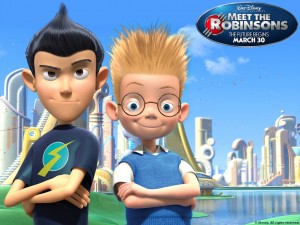
Meet the RobinsonsWhich is why I was initially attracted to the trailer for Disney’s Meet the Robinsons, a CGI feature from several years ago.  It had some odball humor — like the Tyrannosaurus Rex villain complaining about his stubby, useless arms — and a kid inventor protagonist.  But I was worried that the kid would be a Jimmy Neutron knock-off, always rocketing around in inventions of his own making.

That’s not Meet the Robinsons.  Lewis, the protagonist, is a deeply conflicted 12-year-old: an orphan whose inventions have never worked. He sees himself as a failure with no identity.

Those become the film’s themes: failure and identity.  What is failure?  And are we determined by our genes or our choices?

In my opinion, this is a Pixar-quality film.  Now, I personally don’t deify Pixar.  While I enjoy all of Pixar’s films, a couple of them (A Bug’s Life, Finding Nemo, and Monsters, Inc.) never grabbed me.

This flick grabbed me. Lewis is instantly likable, from his love of technology to his passion for invention and improving the world.  He’s a kid, which a lot of kids’ films seem to forget about. He’s innocent without being naïve.

He also genuinely hurts.  He’s not a genius adventurer; he’s a flawed boy, who is also a genius and goes on an adventure.  There’s a huge difference, and it’s a hallmark of Pixar-like storytelling.

I’ve long said that Disney animators could animate rocks effectively, and Meet the Robinsons proves it.  Despite being relatively unfamiliar with CGI, the animators bring emotion and reality to the characters. For example, during a scene with one primary character, secondary characters react and go through their own emotional arcs while in the background. And they don’t follow familiar facial reactions.

Note:  Brad Bird, director of The Incredibles, was once asked to identify the biggest strength and the biggest weakness of the newest generation of animators. He replied that it was the same thing: we have decades’ worth of animation that we can study, and it can be done by pausing DVDs at its simplest level. But that study can lead to imitation. He described watching current animated films and saying to himself, “Okay, there’s walk #5, and there’s shocked expression #3, and there’s grin #6.”

Now, John Lasseter was heavily involved with this film, and according to IMDb was responsible for reshoots on 60% of the footage.  But those were larger creative directions for the story, not directives for individual animators.  This film demonstrates tremendous craft.

And the story’s inspirational.  It’s about simple truths, told in a way that’s affecting, memorable, beautiful, and touching. I teared up at the end, because the end celebrated the tremendous potential of humanity.

I work for Amazon. The content on this site is my own and doesn’t necessarily represent Amazon’s position.