15 Thoughts on the iPad (updated)

The iPadA dry description of the iPad’s actual features and usability will not sell anyone who doesn’t want one.

Nevertheless, here’s a list of my impressions:

  • It’s slick. This is what Apple can do: make something we’ve all seen demos of feel not only practical, but sexy.
  • Every basic part of the device works well, and the hardware feels more solid than the iPhone’s. The accelerometer feels more sensitive and the screen crisper than an iPhone.
  • The apps work as advertised.
  • Typing is easy. Not awkward at all.
  • The screen can get smudged easily, but really, there are worse burdens to bear in this life.
  • It doesn’t feel heavy to me, considering the fact that it’s basically a laptop screen.  Some Kindle users complain that it’s heavier than a Kindle 2, and that’s certainly true; I wouldn’t want to hold this upright with one hand for hours.  But that’s fine; it is basically a laptop screen.  It’s not going to be light.
  • Games normally hold little attraction for me anymore, but with the iPad I’ve gotten back into gaming a bit. I’ve logged several hours on Warpgate HD, a Privateer-like space trading and combat game. The Pac-Man emulator works perfectly. Mirror’s Edge is a disappointment (they turned it into a side-scroller), and FPS’s are just too hard to control.
  • The Kindle app looks gorgeous. Works flawlessly, too.
  • I still prefer my Kindle DX for reading. The solid state screen on the Kindle is much easier on the eyes for long periods.
  • I’ve been using Evernote for my Getting Things Done to-do lists. Works fine so far. Great having my lists on an ultraportable device, and the ability to easily add, change, and remove items is an advantage over paper.
  • There’s an app called Comics, which lets you read American comics. Wow. I read through the first issue of a Warren Ellis-written Iron Man story, and…well, for US $2 I could download and read an issue of Iron Man. Tremendously valuable. You can double-tap on a panel to zoom in on it, too.
  • I watched the first few minutes of The Big Sleep using the NetFlix app (which also lets you manage your queues as effectively as on their website). I like the idea of being able to watch TV shows and movies on the iPad, though I don’t know why I’d do so there instead of on my larger laptop or projector.
  • You can load any iPhone or iPod Touch app on the iPad, which can be doubled in size to take up the full iPad screen real estate. This looks acceptable for most apps, but for games, the effect is cartoony and pixellated.
  • An option in iTunes will automatically down-sample all MP3s to 128 mbps when transferring to the iPad. I went from about 28 GBs of music (which is just a subset of my collection) to about 8 that way; I think I can put all my music on the iPad.
    • For you non-techies, let me translate: 128 kbps is a relatively high quality rating, but many songs files are generated at an even higher quality.  There’s a checkbox in iTunes that, when checked, will convert any songs higher in quality than 128 kbps to 128 kbps before transferring them to the iPad.  This can save tremendous amounts of storage space.
  • The lack of Flash is something of a relief. I get fewer annoying, interactive banner ads. The video sites that I care about (YouTube, Vimeo) already support HTML 5 video, and I hope that will be the future of online video anyway.

Overall: Do I like it? Yes. Is it worth the money? That’s an individual decision. It’s worth my money, if just because I get to hold a bit of the future in my hands.
Gaming the Social

"2008 Renaissance Festival 100" by anoldent on FlickrI’ve become interested recently in the topic of role-playing social interactions. In a tabletop RPG, characters often have to talk with enemies as well as short-term antagonists — the arms dealer who’s willing to cut them a deal, the mayor from whom they need permission for an investigation, a boy who doesn’t want to talk.

A good example has just come up in my Star Wars Google Wave game; while investigating the disappearance of several Adascorp freighters–in which the Hutts looked to be involved–the players accepted a job delivering a strange package to someone named Klek. They found the bar where Klek lived, were sent into a back room, and were greeted by Klek the Hutt.

How do players deal with that sort of situation? Wouldn’t it be cool if a role-playing system provided specific mechanics to help the players wrap their brains around the challenge, in the same way that they provide mechanics for physical combat and uses of skills?

Note:  Yes, this could be treated like a skill challenge in D&D 4E, but skill challenges have simple binary outcomes. You succeed or you fail. Social interaction is never that simple.

In pursuit of this, I bought a copy of Blue Rose, “the role-playing game of romantic fantasy,” which focuses more on court intrigue than combat. Great! Then I discovered it uses a minor variation on the True20 system. I love True20, but I’m looking for something more tailored than that.

So I spent some time last week hashing out some variables for a social-oriented system. Here’s what I’ve got so far:

Character Attributes

Each player-character has six characteristics:

  • Honor
  • Beauty
  • Psychic/Magical Ability
  • Charisma
  • Craftiness
  • Physical Endurance

To determine your character’s stats in these, roll a d100 (or a percentile die and a d10) for each of the above attributes. If all six rolls total 500 or more, re-roll. A low score indicates a low ability; a high score indicates a high ability.

Note: I’d like to add charts for each of these characteristics, indicating the overall distribution of these numbers across the population. Someone in the lowest 5% of psychic ability, for example, is anti-psychic; no psychic abilities can be used within 10 meters of the individual. Someone in the highest 93% are particularly gifted.

In addition, each character rolls a d100 for each of three types of resources:

  • Knowledge
  • Money
  • Influence

That influence score can then be divided amongst the various organizations over which the character has influence, depending on the setting.  For example, in a Medieval European setting where one plays a noble, one may have influence over one’s serfs, the clergy, and the crown.

Each character also has at least one character goal.  These are all in-world accomplishments of any scope; rescue the princess, become a knight, make a million credits, or atone for my past sins.

Moreover, each character maps his or her relationships with the other notable characters and groups in the game, on a scale of -4 (worst enemy) to +4 (best friends/intimate lovers), and an emotional bank from 0 to 5, indicating how much energy they’re willing to devote to social interactions. I’m not sure whether the emotional bank should be one overall score, or individualized to specific people and groups.

"So where do you want me to go?" by "Mercedes.. Life as I picture it" on FlickrPlaying a Social Conflict

When a social conflict begins, each side in the conflict determines their conflict goals, such as “Increase the Queen’s relationship with me to +1” or “Find out what Don Ferrigno knows about the death of Jericho Fats.”

Character goals are kept hidden (unless they’re generally known), but may be revealed during the conflict.

There are no die rolls during a social conflict.  Each character asks for help, offers information or resources, etc., which may or may not be accepted by the other characters.

Doing a small favor for someone may increase that character’s emotional bank by 1; a big favor by 3.  Once the emotional bank hits 5, the relationship score increases by one rank and the emotional bank resets to 1.  If the emotional bank drops below 0, the relationship score decreases by one rank.

As characters interact with the world, their resources change. Their characteristics can also be affected, of course.

Were I to include a combat mechanic, I’d use something like Fudge: each weapon provides a small bonus (+1 to +3), as does significant armor.  Roll Fudge dice (which provide -4 to +4), add the result to any weapon bonuses, and compare to the opponent’s armor value. If you meet or beat the armor rating, you hit. There are enough damage systems in the world that I leave that to the reader’s imagination.

What do you think?

A covering, a shield, a container

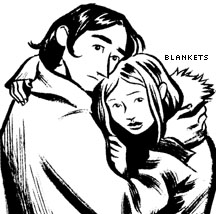
A panel from Blankets, by Craig Thompson

Last night, I met with a couple of old and new friends to talk about Craig Thompson’s Blankets.

Blankets is a 500-page graphic novel that helped to establish the American graphic novel scene. It’s a memoir of the artist’s childhood and teen years, centering on his childhood relationship with his kid brother and his teen relationship with a girl.

Disconnection and relationship form the book’s two major themes, which is fitting, considering the situation: a couple of guys, some of whom know each other and some of whom don’t, sitting down and wrestling with a book.

We remarked later about the importance of gatherings like this. Of spending a few hours with other people, talking, debating, pointing things out.  This is how relationships are made.

Moreover, relationship is a fuzzy, organic thing — the group doesn’t have a moment where everybody stands up and shouts, “I’m interfaced!”1 It’s not a binary thing. We talk and we grow closer, and the group becomes more. Different.

The work comes first, then the rewards of sharing and relationship and support. But first, slices of bread and opinions, shared across a table.


1 Yes, that’s an MST3K reference to Overdrawn at the Memory Bank.

Azeroth is not Faerûn: MMO Minds in Tabletop RPGs

Cracked has an excellent article on 5 Creepy Ways Video Games Are Trying to Get You Addicted. It’s not simple scare-mongering — though there’s certainly a hushed tone of passion in the article — and it sparked some neurons in my brain about mental models and tabletop role-playing.

Dungeons and Dragons Adventuring Party

© Wizards of the Coast, D&D 3.5 Player's Guide

My first GMing experiences were spent with players themselves unfamiliar with tabletop role-playing. We mostly knew each other, and we had a shared, unspoken belief in exploration. We came into tabletop gaming with few preconceptions and fewer goals. We just wanted to try out this “new” thing.

When I began GMing in earnest later, I noticed an interesting phenomenon: players applying online gaming experience to tabletop gamingWorld of Warcraft players were–consciously or subconsciously–creating characters that fit their online gaming experience.

On the one hand, applying related knowledge makes sense. However, the key word here is related knowledge. It’s unwise to assume that computer gaming is similar to tabletop gaming.

Okay, time for an example: I had one player say that we needed a character who’d “pull aggro.” Direct quote. For those unfamiliar with World of Warcraft, aggro is a term for aggressiveness, a quality that monsters use to determine which enemy to attack.  A standard WoW tactic involves crafting characters that can attract the enemy’s attention and soak up large amounts of damage, distracting the enemy from physically weaker characters that are helping from the sidelines.

In tabletop games, there is no aggro. The GM decides in the moment which monster attacks which character. The mechanical rules required for a computer game are just that: mechanical rules, simplifications to give the monsters something reasonable to do.

Similarly, I’ve had players refuse to play characters that interest them because the party didn’t have a character that filled a particular standard party role.  I’m starting to get angry when I hear the oft-repeated claim, “We won’t last a week without a healer. Who wants to play a cleric?”

In tabletop, it’s the GM’s job to craft encounters that challenge the party. If the party doesn’t have healers, the GM has to take that into account. That’s not a deficiency in the party.  A GM who can’t deal with this–or who ignores it, or who exploits it to kill the party–is a bad GM, and should not be gamed with.

Play whatever character you want to play. A party of all monks isn’t imbalanced; it’s awesome.

Spark Some Debate in your Book Club

"Book Addiction" by Emiline220 on Flickr

My friend Nick graciously invited me to a short-lived book club: two sessions, this coming week, discussing Craig Thompson’s graphic novel Blankets. Brilliant idea: debate one book, and we’re done. We can convene again if it goes well. Minimal pressure.

I decided I wanted some ammunition besides my memories and my hand-written notes, so I just went online to find some awesome, inspiring, deep book club questions.

I couldn’t find any.

Plenty of advice on how to start a book club, the sorts of finger foods to serve, and a few generic questions (“What did you like about the book?”).

So, I hereby propose a few questions to get people thinking about and debating a book:

  • When you think about the book, what’s the first thing that you remember?
  • What are the turning points in the story?
  • What stood out?
  • What made you uncomfortable?
  • Which was the most memorable character?
  • What do you disagree with?
  • If someone asked you why they should read this book, what would you say?
  • What was weird?  Was the weirdness effective?  That is, did it add something?
  • If you had written this, what would you have done differently?

What would you add to the list?

Tech is Complicated

As some of you may know, the classic arcade game cabinet that I built about a year ago died a while back.  Couldn’t even get to the BIOS.

I asked around on Freecycle for anyone local willing to get rid of an older computer.  Unfortunately, the replies I received were from people trying to get rid of ancient computers, like 386s.  That wasn’t quite sufficient.

Finally, on Wednesday, I broke down and bought a $200 desktop EeePC.  It came with Windows, a lot of games, and not much else.  I forgot how stripped down those things are:  no CD-ROM drive and no wireless card.

Of more direct concern:  it came with Windows XP pre-installed.  The first iteration of my game cabinet ran Ubuntu Linux, which drove the big question:

Do I keep Windows on it and struggle to set that up for what I need, or do I struggle to install Ubuntu and then set it up using my “known good” configuration?

This is how technology is complicated.  It’s not so much the complexity of the components; it’s the complexity of their interaction.

The EeePC isn’t built to support the installation of a Linux OS.  It’s just not easy to do (my initial attempts to boot off a USB drive were complete failure).

On the other side of the fence, it’s much harder to configure Windows and the various apps for exactly what I want to do (start an app in full-screen mode, for example).

There’s no right answer.  One makes a choice and moves forward in one direction.

I spent a few hours trying to install Ubuntu via a USB drive. Unfortunately, the EeePC simply wouldn’t boot off of USB, no matter what I did, and some Googling indicated that EeePC desktops often have that problem.

So I abandoned Ubuntu and concentrated on installing MameUI. After fiddling with the keyboard controls, I finally got it mostly, essentially, working. I’ve still got a few more things to fix, but I can play games on my cabinet now.

This is why optimization rarely works. We can’t know what’ll work until we try.

Denial is a Form of Freedom

Lamp, by didbygraham on Flickr

Lamp, by didbygraham on Flickr

This week, I started a new role-playing game. I’m running it very differently than I run most games. It’s a D&D 4th edition game, created primarily to test out the classes and races in the new third Player’s Handbook.

Since I’m already running two other games, which takes up much of my time, I decided to run this game using almost entirely pre-published materials. I bought a dungeon crawl-style adventure (more accurately, a “temple crawl”).  Very little world design is required on my end.

This is weird. I love to create worlds; I typically spend a lot of time fleshing out my gaming worlds.

But this frees me up to do that in other games, and to just run the game.  I can focus on NPCs and larger world questions (I’m thinking of adding a Tékumel-style empire).

As with so many things, denial is a form of freedom.

Energy

over the sun, by mindfulness on Flickr

A personal proposal:

Physical Energy Maintenance:

Every night: 5 minutes of Tai Chi, a 30-second push-up, a 30-second sit-up, and a few minutes of strength training with an infinite resistance machine.

Three times a week: 20 minutes of running.

Emotional Energy Maintenance:

Every morning: 5 minutes of journaling.

Spiritual Energy Maintenance:

Every week: Church attendance, and helping out with church youth group

Mental Energy Maintenance:

Every night: Read a book for 30 minutes.

Every week: Read magazines for 1 hour.

Every two weeks: Research something in detail, beyond just jumping around Google.

Switcheroo

Ironic, how much of wise living consists of resisting one’s impulses.

All’s Faire

Imagine the cheesiest, cheapest Renaissance Faire possible.  Imagine the weird, driven employees of said Fair.  Imagine the Faire’s in danger of shutting down, and what those employees would do to keep “their” Faire going.

All's Faire screenshotThat’s the premise of All’s Faire, a serial comedy showing on blip.tv.  I stumbled across this on my Roku a few months ago, and was hooked by, of all things, the acting.

This show is full of impressive comedic performances. I’d love to know where they found these actors. There’s the over-the-hill owner and king of the fair, the over-eager minstrels (who are composing a “Medieval Rock Opera”), a wide-eyed “wench,” a vain knight, a “Celtic warrior” absolutely dedicated to realism (he’s vowed not to break character until the end of the season), and the long-suffering manager.  And that’s only about half of the cast.

Sure, there’s no Laurence Olivier here, but this is a shoestring-budgeted comedy, and it works. Each episode advances the plot–if slightly–and clocks in at under ten minutes long.

Better, because there’s an actual story, the show doesn’t have to fall back on one actor’s comedic skills.  They bring what they have to each scene and problem.

I work for Amazon. The content on this site is my own and doesn’t necessarily represent Amazon’s position.