Excitement

It’s rainy, and I have a sore mouth, and a sore arm.  But I’m excited, for two reasons:

1) I pulled all my old blog entries off the Internet Archive, wrote a quick Python script that converted them into an RSS feed, and imported them into this blog. I’m still cleaning them up, but for the first time in a decade I have my entire blog, all in one place.  All twelve years of it.

It’s a silly project, in a way. But this is part of me, and it just felt right to consolidate it all in an easy-to-browse way. I’ve been reading back through it, and man have I been a jerk at times.

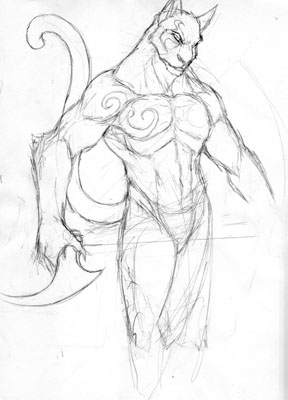
2) I’m working with an artist to re-start Red Ax, a comic idea I had several years ago, but never got off the ground. Here are some samples of the artwork:

Ax

Ax, the protagonist

Ax

Ax, possible cover image

Red Ax, antagonist

The initial antagonist

Why am I restarting a comic book?

I’ve been reading a lot of comics lately.  Naoki Urasawa’s Pluto, Warren Ellis’s Transmetropolitan, Scott Pilgrim, the recent Unknown Soldier remake.  A wide sampling, really.

I’ve loved the comic medium for many years, despite a singular disinterest in the comics market during my youth (I’ve never been particularly enthralled by costumed superhero stories).  While my drawing skills are improving, I can’t draw like a pro yet.  So, I’m hiring an artist for this one.

Also, fortunately, the Red Ax story has stuck with me for years.  Many stories are products of their time; after a few years, they no longer tug at my brain.  This one does, and this feels like a good time to start this up again.

Why not?

Anna Karenina

Greta Garbo playing Anna Karenina

Greta Garbo playing Anna Karenina

I finished reading Joel Carnegie’s translation of Tolstoy’s Anna Karenina a few days ago.

This isn’t a review. What could I offer that thousands of other reviewers haven’t?

However, I will point out three things that stuck out at me:

1) This was an eminently readable book.  This undoubtedly has much to do with Carmichael’s translation. For example, according to his notes, he spent a great deal of time deciding on the most natural method of referring to characters’ names.

The Russian style of referring to people by “Name Son/Daughter-of-Parent,” such as “Ivan Petrovich” (Ivan Son-of-Peter), simply sounds foreign to non-Russian ears, so he changed that throughout the book. The result still captures the author’s intent, which is not to confuse readers.

2) To paraphrase my mother’s reaction to the book, I never thought there were so many thoroughly modern people living a hundred years ago in Russia. I felt their pain and frustration as thoroughly as I do my friends’.

3) Anna Karenina is a strongly moral story. Characters make mistakes and live with them. The book is careful not to judge them, and just as careful to point out the consequences of immoral behavior.

And finally, an obligatory note to all you struggling writers out there: When Anna Karenina was first published, the critics dismissed it as a “trifling romance of high life,” according to Wikipedia. Ha!

Four Months of Gaming in Google Wave

I received my invitation to Google Wave in late October, and after puttering around for a bit, quickly became involved in the role-playing scene on Wave. I joined a few games and started a few games, and I now run one of the longest-running games on Wave.  I’m on Wave just about every day.

Wave is a nearly ideal online role-playing platform.  Its design allows for easy discussion that’s quick to read (no huge signature blocks or author stats), and it’s obvious when several people are online at the same time (you can see them typing).  The ability to edit posts is perfect for maps and monster trackers; when a battle begins, I create one message for the map and each character’s turn order and hit points, which we update as the battle progresses.

The easy malleability of Waves also keep resources from getting stale; just last week, the main index of active role-playing games on Wave–which had grown full of dead games–was re-organized by a handful of volunteers.  In about two days.

The main downside:  a lot of people jump on Wave excitedly, horse around for a while, then forget about it.  My Star Wars game has lost quite a few players (particularly around the Christmas holidays).  Still, that’s true of any technology these days, and to be fair role-playing is one of the few activities in which that’s particularly disruptive.

Overall, it’s been a great experience.

Beatdown Distraction

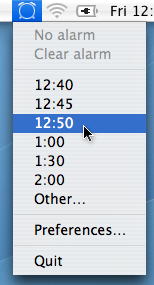
TinyAlarm Screenshot

Screenshot of TinyAlarm

We’ve all been there: it’s late in the evening, you meant to be working on your current Big Project, and you suddenly realize you’ve spent the past two hours flipping through unrelated Wikipedia pages. Not because you were bored; you just got distracted.

This happens to me when I’ve been racing around for most of the evening–cooking, recording videos, checking emails. I haven’t rested, so eventually my mind forces rest by distracting me with inanity.

So I’ve been using an app called TinyAlarm on my Mac. I set it for 30 minutes, after which it chirps, telling me to stop whatever I’m doing and rest for a bit.

Of course, “rest” can mean a lot of things; reading, making a drink, putting a book away, etc. It can be anything different from what I was doing.

It’s also a great opportunity to take a step back and look at what I’m doing. I often realize that I’ve become distracted within the work I was doing, concentrating on a less-important aspect of the job. These 30-minute breaks help me to refocus on what’s most important.

How do you refocus?

Transmetropolitan: GO

I just (literally, just) finished reading Transmetropolitan volume 1.  And to understand it, I must explain its context.

Unfortunately, I hardly know its context myself; I wasn’t into comics when Transmetropolitan debuted in 1997. I did (and do) have enough hazy awareness of the American comic scene to know that it was absolutely dominated by spandex-clad superheroes.

Along came Warren Ellis, telling the story of an insane reporter (Spider Jerusalem; what a great name) in an insane city of hyper-violence and daily sex. Moreover, this reporter is Tyler Durden. He’s a swift, hard kick in the hindquarters of business-as-usual society. A Messiah for Manhattan (if that weren’t clear, the scene where he literally overturns the tables of the various religious leaders demonstrates it to an almost painfully didactic clarity).

So you get the over-the-top action of a modern American comic book, but the guy getting his teeth knocked in isn’t Doctor Octopus or the Riddler; it’s a rag-clothed vagrant or a street cop. There are no superheroes here. Heck, there are no heroes.

The artwork is Watchmen crossed with Sam & Max; sharp, simple, recognizable, and filled with parody. Darick Robertson’s art shows an appreciation of the comics medium rarely surpassed; this is one of the few truly cinematic comics out there.  Just one of the dizzying situations in volume one: Spider sitting on the edge of a building, laptop in hand, surrounded by half a dozen strippers he’s “rescued” from a mob below, bathed in neon as he live-blogsfull-scale riot occurring on the streets below.

Which demonstrates both the primary strength and the primary weakness of this volume.  For 1997, Ellis writes an impressively accurate rendition of the near future.  Obviously, we’re not there yet, not will we be (I hope), but the trends he demonstrates feel eerily prescient.

On the other hand, much of this volume feels like wish fulfillment.  I mean, seriously, a writer surrounded by sexy, half-naked strippers, writing feverishly–and gaining massive success because of it? A reporter who literally kicks down the doors of the establishment and eloquently tells everyone that annoys him to f*** off?  The world and style of Transmetropolitan are so outlandish that Ellis mostly gets away with this; you get the feeling that crazy stuff like this is happening everywhere in the city to various extents. But Spider still struck me as a massive Mary Sue, albeit an extremely well-written one.

That’s Quite Interesting

I’ve been feeling ill today, so as usual when I’m feeling ill, I spent most of the day on YouTube, watching Craig Ferguson and QI.

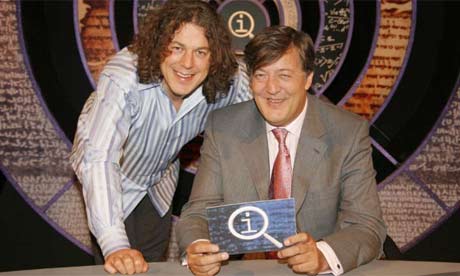
Alan Davies and Stephen Fry on the set of QI

QI is a BBC TV program(me) hosted by Stephen Fry. It’s nominally a quiz show, but in the spirit of Whose Line Is It Anyway (and undoubtedly dozens of other BBC program[me]s), the points don’t matter. Stephen brings in four comedians, asks amazingly obscure questions primarily to prompt the panelists to respond with some funny lines.

Stephen also attempts to predict the most obvious answers, and if those are guessed, an alarm goes off. Players get extra points for saying anything that’s Quite Interesting, which is the origin of the show’s title.

It’s all a lot of genial fun, full of banter and interesting asides. An example:

Stephen Fry: “But one thing [Thomas] Edison did invent. A 100% genuine Edison invention, that we use every day, probably, most of us.”

Jimmy Carr: “Is it nasal hair clippers?”

Stephen Fry: “No; it’s not even an object.”

Bill Bailey: “So it’s a way of being. Sarcasm!”

Stephen Fry: (laughing, then sarcastically) “Oh, yeah, he invented sarcasm.” (rolls eyes)

The answer, incidentally, is the word “Hello.” There was a genuine in Edison’s time need for a word to respond when answering a telephone, and Edison retooled the British word of surprise, “Hullo!”

Now isn’t that Quite Interesting?

A Flash Upon the Inward Eye

Enough of my own, hand-grown code full of nasty surprises. Time for something easy and powerful.

I’ve completely redesigned my website, as you’ve no doubt noticed.  Each section is its own creation.  If I want a blog, I have a blog, not some weird hand-crafted thing.

When You Have Nothing More To Give

[IMAGE]

What do you do when your psychological tank’s empty?

I’m facing that today. I had an exhausting week at work, classes started Wednesday, and I DMed for 4 hours last night. It’s now Saturday morning, and I’m trying not to crash.

You recharge. You do those things that truly satisfy, that excite you.

Of course, you have to find those things. A lot of people seem to think that TV recharges; no. TV relaxes. Different thing.

We’re looking for something that energizes. It’s different for different people, of course. For example, I’m recharged by:

  • Books
  • Unusual magazines
  • Good anime
  • Comics
  • Experimentation

What recharges you?

Coming This Summer

This is what happens when I play around on the computer for an hour:

[IMAGE]

Kindle 1 vs. Kindle 2 vs. Sony eReader

[IMAGE]

About a week ago, I received an email asking me my opinion on the Kindle versus the Sony eReader for a particular situation. I offered some advice, and was asked to post the conversation on my blog here, for the world’s benefit. So, here you go:

My girlfriend wants to buy me a Kindle. I’m about average to slightly above average on my level of reading; about 1 book a month.

I have done a bit of reading on the net, and I really can’t tell if a Kindle or Kindle 2 or Sony reader or some other option would be best.

Doesn’t Sony allow you to purchase ebooks from various sources and share it to other devices, while Amazon ebooks are only useable on Kindle?

I’ll start with the final question. All of the ereaders support formats other than their store’s standard format. For example, besides the Kindle Store’s .azw format, Kindle supports .mobi, .prc, .rtf, .pdf, and .txt natively, as well as Word documents through a free conversion service. Sony’s and B&N’s have similar setups.

The Kindle’s big advantage is its market share — it offers a wide variety of current and older books, at (usually) lower prices than its competitors. Generally, more of your favorite books will be available for Kindle than the others.

As to which Kindle is best: For what it’s worth, I’ve owned all three major versions of Kindle: 1, 2, and DX. I like the DX because of its larger screen size; it’s like reading a hardback book compared to a paperback. It’s just nicer that way. Most of the folks who prefer a Kindle 2 want to be able to put it in a purse, or just want something very lightweight; I personally don’t have those needs. The DX isn’t particularly heavy anyway.

As to whether you should get a Kindle at all: I’ll say that I was a fairly heavy reader before getting my Kindle (several books a month), and I became a heavier reader after getting it.

Its free samples made it much easier to check out genres I never would have looked at before. If friends recommend a novel, I can easily check out the first chapter or so, without standing in a bookstore for 10 minutes.

Would you recommend the K1 or K2?

I prefer the K2 to the K1, as I find the K1’s scroll wheel clunky. It works, but it’s not nearly as convenient as the K2’s mini-joystick.

A lot of people who like the K1 point to the SD slot and the replaceable battery.

On the SD slot — it caused quite a few problems on the K1, as something that would often get stuck or otherwise confuse the OS. Also, there’s no need to store tons of books on the Kindle; all the purchased books are backed up by Amazon, and anything else would be backed up on one’s computer (I should hope!). One will never be away from a computer long enough to get through a thousand books stored on the device, if you get my meaning.

On the replaceable battery — that type of battery (Lithium-Ion, I believe) dies even when it’s not being used. So a replacement will age about as quickly as the battery in the Kindle, so when the Kindle’s battery dies, the replacement will already be about dead. Moreover, Kindle 2 and DX battery replacements are done with overnight shipping, so one would only be without one’s Kindle for a couple of days.

K1’s a fine device, but I just don’t think it’s worth it when it has a clunkier UI. But that’s just me!
I work for Amazon. The content on this site is my own and doesn’t necessarily represent Amazon’s position.