50 Games in 50 Weeks: Pathfinder Arena

'Slaying the Dragon' by fireflythegreat on Flickr

‘Slaying the Dragon’ by fireflythegreat on Flickr

I have a difficult time reviewing this without getting snarky. So I’m going to get a bit snarky.

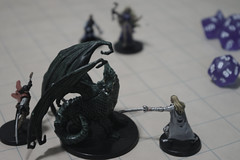
While I was at PAX East 2012, a friend and I walked by a table the size of a Mini Cooper. It was ringed with miniature walls and its surface sprayed with a sandy finish, so it looked like a miniature gladiatorial arena. Beautiful work.

We approached the two men who stood nearby and asked them what it was. They explained it was designed for an ongoing gladiatorial game they’d designed using miniatures. Anyone at the con could walk up, pick up a character, “enter the arena,” and fight until their character died.

We agreed to join, and asked about the system. Here’s where it got weird.

The referee explained that they had designed their game around D&D 3rd Edition and Pathfinder. They made it clear they had not used 4th Edition, which they hated; they had taken Pathfinder/3E and adapted them for this. Then they handed us our character sheets and explained their system.

Now, my friend and I played a lot of 4th Edition D&D. As these two men talked, my friend and I glanced at each other, our eyes full of meaning.

Every single change made to this system was a 4th Edition change. This game looked almost exactly like 4th Edition.

The prime complaint about 4th Edition was that it made D&D feel like a war game. And this revision did exactly that: it adapted 3rd Edition for grid-based tactical combat.

I don’t say this to shame the designers; I do this because the game worked extremely well. Combat moved quickly, and we had a few useful choices at any given time, while combat remained unpredictable. The designers made the right decisions, which made their game almost exactly like the 4th Edition they claimed to despise.

Unfortunately, I don’t know the name they gave their game, so I call it Pathfinder Arena. As a minis-based arena combat game, it works very well.
Launching a Comic: Red Ax

Many years ago, I had an idea for a comic book, and the idea stuck. It grabbed onto a corner of my mind, whispering ideas, until finally I wrote it down. Within a few days, I’d written a comic book script good for 13double-sidedpages.

It’s weird. It whispered a story about anthromorphic cats in a quasi-medieval, quasi-Arabian, quasi-Asianworld, focusing on a mutesword-for-hireand a slave.

It needed an artist. I didn’t have the skills.

Now what?

Fortune favored me. Through another project, I found H. Davidson.

Red Ax stack

H draws professional-qualityanthro art. She studies anatomy. Her figures have grace and depth. She was exactly what I needed.

So, for the past year, she’s been drawing issue 1 of Red Ax. A month ago, she finished.

Now what?

I need to write the rest of the story. And while in the past I would have posted written jumped right in and just written whatever came to mind, this time I want to get inspired first.

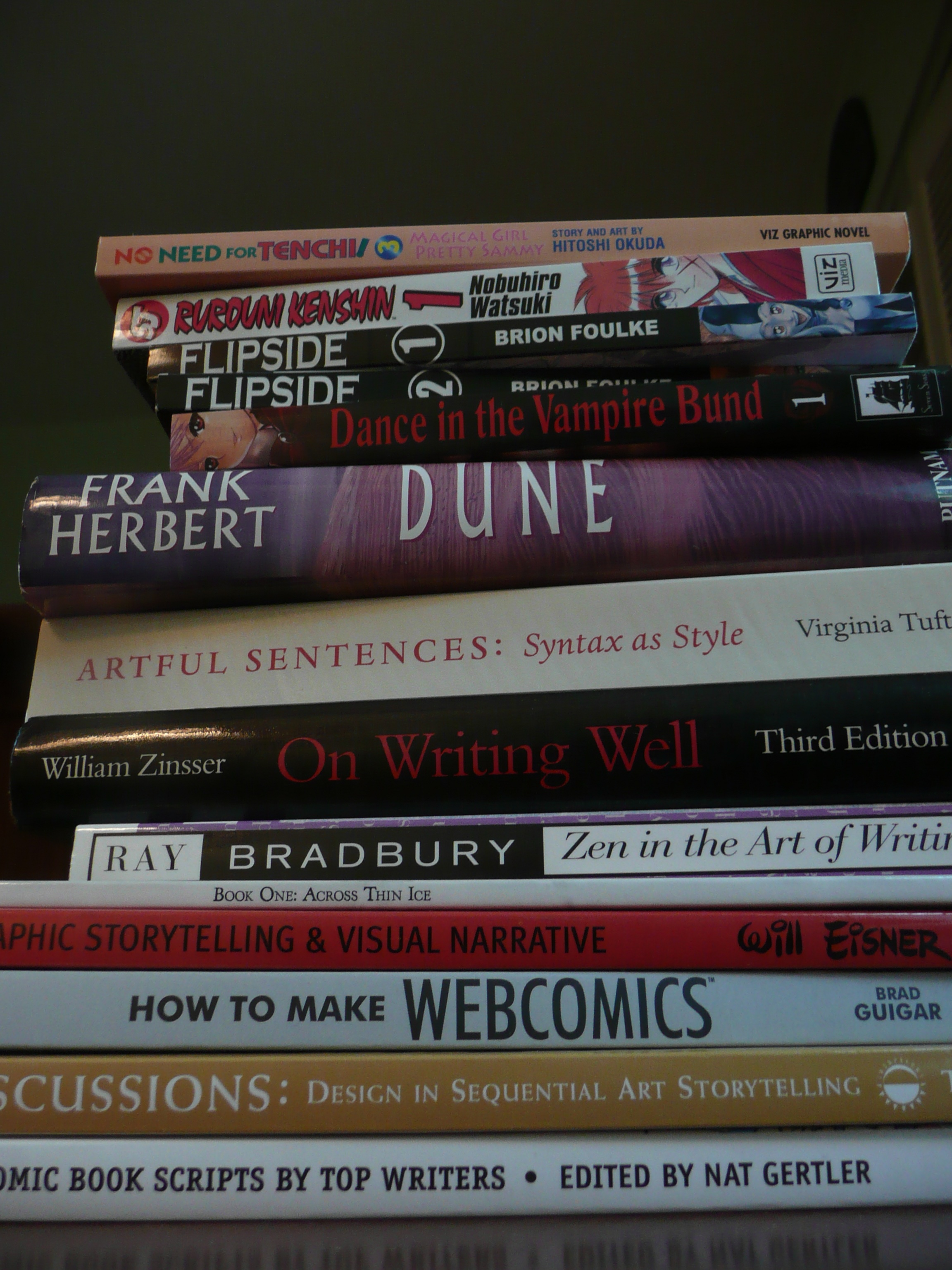
So, what you see to the upper-rightis the stack of books I plan to re-read(or at least skim) as I prepare. As I read, I’ll plan and write and take notes. I hope to finish writing issue 2 by the end of September, at which point I should be able to release issue 1 and talk more firmly about Red Ax‘s future. Meanwhile, I’ll post images from issue 1 throughout September.

Here’s a teaser:

Page 4 detail

Isn’t that awesome?

50 Games in 50 Weeks: Old School Hack

Old School Hack logoHoly guacamole, do I love this game.

Imagine if Arneson and Gygax were teleported from 1970 to the modern day, and shown all sorts of modern RPGs. Then teleport them back to 1970. Old School Hack is how they would have designed Dungeons & Dragons.

OSH is part of the Old School Renaissance, but rather than re-using the mechanics of early D&D, it provides modern approaches to the classic swords-and-elves experience, without turning it into a completely modern game. OSH feels retro.

For example, distance in combat is represented by arenas, a.k.a. blobs of terrain. An arena’s exact size or shape isn’t important; they simply represent relative proximity. So, players can easily use existing maps without wrestling a grid on top  of it, while the map can still be subdivided into meaningful arenas.

OSH provides seven classes. If you pick one, you’re the only player this game with that class. This ensures that everyone has a unique role. You also get a character sheet representing just that class’s abilities and talents.

Talents are spell-like powers that can be used periodically, much like D&D 4th Edition’s powers. At first level, you choose one talent and may use it during the game. At each additional level, you choose an additional talent. Simple.

Speaking of leveling up: there are only 4 levels in Old School Hack. This strikes me as wise; the designer didn’t try to design beyond his experience or play-testing could reach.

Interestingly, turn order is determined by the type of action your character takes. Those choosing to hunker down in total defense go first, followed by ranged attacks, spells, movement, melee attacks, and physical grappling. This speeds up combat, to my surprise, because you deal with similar actions at once, leading to fewer context switches. It also gives combat a different feel. If two PCs both stand in the back firing arrows at the enemies, then they’re doing both at the same time both in-game and out-of-game. This adds a sense of camaraderie.

The game’s old-school aesthetic is greatly enhanced by its presentation. The PDF is full of sketchy pencil art. Not illustrations: titles and borders are “drawn in pencil.”

More importantly, the entire system combines to provide a play experience that’s simple to grasp with just enough tactical richness to make each fight unique.

You can download the full PDF for free.

50 Games in 50 Weeks: Houses of the Blooded

I’m building an “RPG Tour,” a set of RPGs that, if played, will give one a broad appreciation for different approaches to tabletop gaming. The list includes DreadFiasco, Old School Hack, and Dungeon World.

I ran my second session of Houses of the Blooded last night, and I’m adding it to the list.

detail of Journey start by jiuge

detail of Journey start by jiuge

Houses is a game of high court intrigue. The players are all powerful nobles struggling to get their way in a complex society.

In many ways, it’s the opposite of D&D. There’s very little combat. The player-characters are so strong they could easily kill dozens of normal people, but are evenly matched against each other. There’s no point in attacking regular people or nobles.

Most of the rulebook isn’t rules; it’s explanations of Blooded society. The game is all about getting into your character’s head and risking yourself.

The game’s mechanics support this, and may blow the minds of traditional RPG players. If you want to risk something, you use different elements of your character to add dice (always six-sided) to a dice pool. Your name is worth one die, one applicable virtue adds as many dice as your score in that virtue, and you can tag one of your Aspects for three dice. (Aspects are taglines that describe your character, like “Aura of innocence” or “Death before dishonor.”)

Before rolling, you may set aside any number of dice from your pool as wagers. You then roll the dice you didn’t set aside and add the results; if you roll 10 or higher, you get to narrate the result. If 9 or lower, the Narrator (GM) narrates the result. If you rolled 10 or higher, then for every die you wagered, you get to add one fact to the result, such as “…and our Houses have a secret pact” or “…she’s actually my wife in disguise.”

This changes the GM’s role. As GM in a game of Houses, I spent 90% of my time playing NPCs. The players truly drove the story.

And by “drove the story,” I mean that we were essentially writing the story as we played. Characters attempted all sorts of investigations and asked all sorts of questions that prompted refusals, confessions, and further plot threads.

Once the group got used to the system–which took about one full session–collaborative storytelling felt easy.

John Rogers once said that the three elements of storytelling are “What do the characters need? Why can’t they get it? And why should I care?” Houses of the Blooded pushes the players to ask and answer those questions in play.

How to Run an Online RPG Convention


'Magnum, P.I.' by Mira Hartford on Flickr

‘Magnum, P.I.’ by Mira Hartford on Flickr

Indie+, an online RPG convention on Google+, finished today. I was one of the four sponsors who co-ordinated and ran the whole thing: 21 games and  7 panels scheduled for all hours of the week, including integration with YouTube, Google+, and a wiki.

A few weeks ago, we put out a call for potential hosts, asking them to add potential games or panels to our wiki. Once the new Event functionality appeared on Google+, we switched to that: we asked hosts to create an Event for their game or panel, then share it with our Indie+ page on Google+. We then re-shared those Events with our followers, and updated a Google Calendar and a schedule on the wiki.

Why did we have both a Google Calendar and a schedule on the wiki? Because we didn’t think about having a GCalendar initially, then someone set it up for us. We couldn’t integrate the GCalendar into the wiki, and folks had been told to fill out the wiki. So we ended up maintaining both.

Then we discovered some misleading terminology and unfortunate functionality within Events. An “Event On Air” couldn’t be streamed live, for example, and starting a Hangout (live video chat) from within an Event blocked it from live streaming, too. So we had to ask hosts to manage the Hangout separately from the Event.

Each sponsor took responsibility for one major element of the con: panels for one person, games for another, etc. This turned out to be a mistake, as we had games spanning a fairly wide range of time zones, so the Game Guy (me) couldn’t always be around to help.

So we leapt over stumbling blocks, and stumbled plenty ourselves. The result? 13 games and 7 panels happened, which was recorded into a total of 36 hours’ worth of indie RPG games and discussions.

Because we went ahead and did it. FILDI.

50 Games in 50 Weeks: Once Upon a Time

This is a weird game.

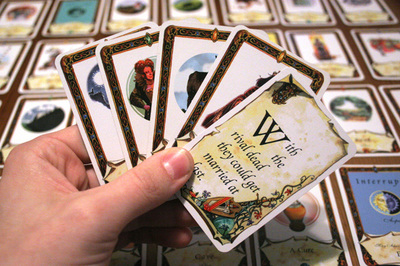
It’s a storytelling card game. Each player has a hand full of fairy tale story elements (swords, siblings, dark places, etc.) and a single ending (“And she was happy the rest of her days,” “And he never saw her again,” etc.). One player begins telling a story, laying down story elements as they appear in the story. However, if another player’s story element appears in the story, then that player may play that card and take over the story. The losing player must then draw an extra story card and stew as the new player continues the story. Similarly, the other players can challenge a player whose story has ceased to make sense, or who has paused for more than a few seconds in telling the story.

The game continues until one player has played all of his or her story elements, and plays his or her ending.

That’s about all of the rules. Sounds chaotic and easy to “game,” right? It is, to begin with. But let me tell you a story.

My favorite session of Once Upon a Time occurred during Guy’s Night Out. Imagine half a dozen college-age guys (and me) sitting around a table, and I pull out this card game. The guys lean forward, intrigued. I deal out the cards. I begin a story.

At first, players slam through their story elements, trying to tell a complete story in two sentences. This behavior is challenged, the relevant players are chastised, and everyone realizes that that tactic just isn’t much fun.

Then, things get interesting, as people realize that they have to tell a good story. On the fly.

Good storytellers are rewarded for weaving a sensible story. One has to weave a story. Give the plot elements room to breathe and grow.

We told stories, laughed, and grew entranced by each others’ stories.

How awesome is that?

Quick Promotion

Indie+ LogoI’m helping to run an online game convention, Indie+. It’s a con run as a set of independently-run games and panels, all organized centrally and run as Google+ Hangouts. It’s running this week.

I volunteered to shepherd the gaming side of things. There are quite a few moving parts, including several different schedules to sync. I figured it’d be no big deal, as we were running this for the first time, so I wouldn’t have too many games to manage.

We have 20 games. Small by most con standards, but a heck of a lot for me to keep track of when it’s my first time and none of it’s automated.

Fortunately, all is going well so far. We’ve got a helpful team running the con, and plenty of interest.

So if you’re interested in RPGs, especially independent ones, head over to the schedule and look for a game or a discussion. Plenty are open for folks to watch. I hope you find something interesting.

(Untitled)

From Tim Kreider‘s article “The ‘Busy’ Trap” in the New York Times:

Idleness is not just a vacation, an indulgence or a vice; it is as indispensable to the brain as vitamin D is to the body, and deprived of it we suffer a mental affliction as disfiguring as rickets. The space and quiet that idleness provides is a necessary condition for standing back from life and seeing it whole, for making unexpected connections and waiting for the wild summer lightning strikes of inspiration — it is, paradoxically, necessary to getting any work done.

The Black Hole

A frustrating day at work. I discovered that a hotel over-charged me for an upcoming trip, because I wasn’t paying attention. I felt despair upon realizing that. Silly, but true. I knew I’d have to call and explain and try to work it out. I felt like a child.

Travel arrangements frequently bring out a feeling of helplessness in me. I feel overwhelmed, even though I have few things to do. I worry that I’ll completely foul it up. I worry that I’ll end up stranded in a foreign city, with no options.

Tomorrow, I have to call the hotel and work this out, dreading every minute of it. Blah.

So I came home and watched some light anime, starting with two episodes of Kids on the Slope. This is the latest series by the director and composer behind the legendary Cowboy Bebop. When I heard it was about teenagers playing jazz together, I was curious. When I watched and discovered it’s a story about growing-up set in 1966 Japan, I was intrigued. Then a piece of Yoko Kanno jazz music hit, and I felt it in my gut. I had so missed that.

Then, three episodes of the original Dirty Pair OVA: girls in metal bikinis, wielding laser guns and causing massive property damage as they pursue criminals. Absolute fun fluff, drawn with care in the inimitable 1980’s anime style. A perfect diversion.

Meanwhile, I continue attempting to keep up with game registrations for Indie+, an online tabletop gaming convention that starts Monday. We’ve established too many beachheads for information, and keeping them all in sync has been a headache. The good news: We have quite a few games scheduled.

Finally, I took a few minutes to cull through the photos I took in the past month. I present them here as a slideshow:


Created with Admarket’s flickrSLiDR.

Worst Film?

Troll 2Tonight, I watched Troll 2. This is considered by many to be the worst film ever made.

And that’s a tough pill for me to swallow. I’ve seen pretty much every episode of Mystery Science Theater 3000. I’ve seen some weird, empty films. I see a phrase like “worst film ever made” as a phrase to be challenged.

Then I ask myself, Am I looking for bright spots just to be contrary, to “prove” that i really know bad movies? Am I just using this as an excuse to look smug and superior?

I hope not. I believe genuinely found some bright spots in Troll 2.

(I’m not going to summarize the plot here. It doesn’t matter.)

The film is effectively edited. Not well, but it’s effective. The camera doesn’t linger over-long on shots, except in a few forgivable instances. The film lacks the inexplicably held shots of, say, Red Zone Cuba or The Skydivers.

There are a couple of downright lovely shots, particularly as the family’s camper pulls in to the vacation home. The location scout picked locations that fit the movie’s mood.

The main character is a pretty good child actor, as child actors go. Kids have a raw simplicity to their performances that usually don’t translate to film well. The actor communicated quite a few different emotions throughout the film.

If you’re willing to suspend your disbelief–which I grant is an extremely difficult task–there are a couple of creepy moments. The representations of tainted food literally liquifying people into green ooze disturbed me, and there are a few (brief) scares.

Note that I’m not suggesting that Troll 2 is good. (I’ll save the subject of “good”‘s meaning for another post.) I’m just saying that the film’s not a complete failure in every respect. It didn’t fail in a few respects.

Everything else is ridiculous.

I work for Amazon. The content on this site is my own and doesn’t necessarily represent Amazon’s position.