50 Games in 50 Weeks: Warrior, Rogue & Mage

Warrior, Rogue, & Mage cover

Warrior, Rogue, & Mage cover

I love Warrior, Rogue & Mage because of its statistical approach to fantasy role-playing.

The System

It’s a beautifully simple system. Instead of various attributes, races, and classes, WR&M uses three attributes: Warrior, Rogue, and Mage. Each player-character has 10 points total to divide among these three attributes. A character with many points in Warrior and few in Rogue or Mage is naturally a fighter of some kind.

In addition, each character has a few skills — which are simply on or off; no ranks or levels — as well as a few talents (special abilities), and four derived attributes: Hit Points based on the Warrior attribute, Fate Points (allowing for re-rolls, ignoring deadly attacks, etc.) based on the Rogue attribute, Mana based on the Mage attribute, and Defense based on Warrior and Rogue. That’s it.

To attempt an action, roll d6 and add it to the appropriate attribute. If the character has an appropriate skill, it adds +2 to the roll. If the result is equal to or higher than a target difficulty level (or the opponent’s Defense, for attacks), the action succeeds. Damage is rolled based on the weapon, and subtracts from Hit Points.

How It Works

Character concepts translate very directly to stats, as do actions. If I want to do something fighty or brawny, I use Warrior. If I want to do something sneaky, I roll Rogue. If I want to use magic, I use Mage.

Even better, you can easily create a character that mixes two or all three of these. You can be the jack-of-all-trades, or an acrobatic fighter, or a hard-hitting battle sorcerer.

Perhaps this is just because of how my mind works, but I found WR&M incredibly easy to grasp. The system got out of the way, while remaining closely relevant to characters’ actions.

You can download it now for free.
50 Games in 50 Weeks: Action Castle

Action Castle logo

Action Castle logo

You may have played early text adventures like Zork or, well, Adventure. They feel strange to those who didn’t play them at the time, like Victorian mechanisms: quaint contraptions for which one can see the intended use, but appear hopelessly outdated and silly.

But there is an ineffable power to interacting with words.

Action Castle brings this experience back to the modern gaming table. Each Action Castle adventure is a short, choose-your-own-adventure style story that one person narrates–as though he or she is the computer–while the player calls out commands in the style of text adventures (“move west”, “take wand”).

Each adventure includes directions to the “computer” about how to respond to queries, to fully replicate the experience of figuring out a text parser’s vocabulary.

As such, games tend to end very quickly, within a few minutes. You can always try again after you die, of course.

My exposure to Action Castle was a single game with a friend who’d bought a few adventures. We ran through the main adventure, “Action Castle.” It was an odd experience, to talk directly to the “computer,” wrestle with the accepted vocabulary, and ultimately die after three rooms.

It wasn’t fun in the sense of joy or happiness. It was a unique opaque puzzle. It burned itself into my memory.

A story about sex?

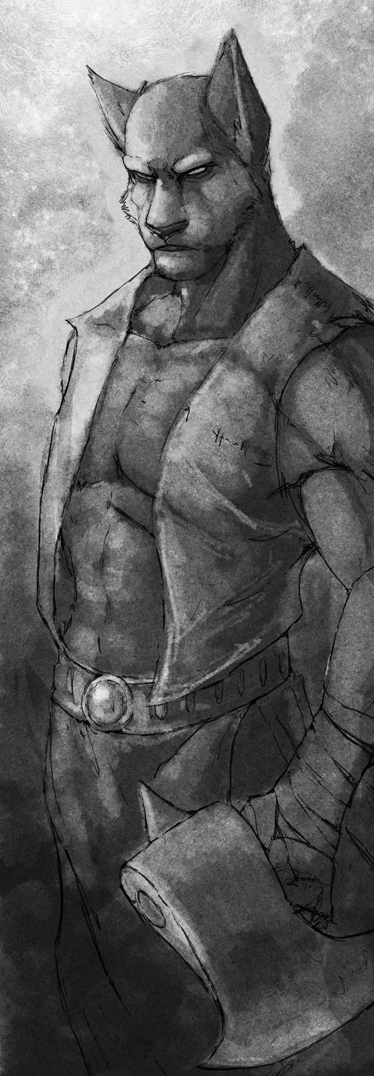
The Red of Red Ax

The Red of Red Ax. Drawn by H. Davidson.

Reminder: You can get issue #1 of Red Ax for only $2.99 at DriveThruComics.

I call Red Ax a story about “sex, ownership, and the lies we tell ourselves.” That’s a mature, adult claim. I make it partly to shake readers up; I want people to think this is not another fluffy action story. I also make this claim partly to encourage readers to take this story seriously.

However, Red Ax isn’t an “M for Mature” title. I intend to write a PG-13 story. Well, maybe a “hard” PG-13.

Red Ax is about sexual behaviors. It’s about a girl who thinks of herself as a sexual object, as having worth primarily through her sexual skills. And it’s about the trap of those beliefs.

Really, it’s about two characters who define themselves through their skills. Sexuality is one of the vessels that this story uses to explore it, and the story doesn’t need explicit sex scenes to do so.

The Story of Red Ax is now being told

Rec Ax, page 2 detail

Red Ax, page 2 detail

As I mentioned in previous articles, I’ve written a comic. A fabulous artist, H. Davidson, drew the first issue.

Now you can download issue 1, free today only. It’s 25 pages of black-and-white art, plus a full-color cover.

This issue introduces the characters, sets up the story, and demonstrates my writing style and H’s amazing artistic skills. This will let you know if you’ll like the rest of the story.

Now, I wrote and paid for issue 1. Unfortunately, comic art is expensive, so I’m going to have to find a way to pay for the production of issue 2. Kickstarter, probably. I’ll also set a price of $2.99 for this issue starting tomorrow.

If you like what you see, please link to it as widely as possible. I literally can’t afford production on later issues until I see the kinds of numbers that will support it. Here’s your chance to make a big comic story become a reality.

50 Games in 50 Weeks: Microscope

'Map of ancient Seoul' by sociate on Flickr

‘Map of ancient Seoul’ by sociate on Flickr

One fun thing about the role-playing hobby is its kaleidoscope of worlds. I get to leap into so many interesting, thought-provoking worlds.

Players often move into world building at some point. And, of course, world building is hard. There are so many variables.

Microscope is a structured game of cooperative world-building. It’s a game you play with friends, but instead of exploring worlds or telling specific stories, you’re creating the history of a world.

One interesting thing about Microscope is its emphasis on writing history. So many world-building tools focus on nailing down details of physics and planet size, while Microscope encourages players to keep the physical world relatively ill-defined.

On to gameplay. Any world needs a few ground rules, so a game of Microscope begins with the Palette. As a group, the players list things that they adamantly do want to include or don’t want included in this world. The palette can include tropes, themes, concepts, and even specific items (“no singing swords”).

Then, each player adds a high-level Period to the world’s history (“The Age of Dragons”) or an Event within an already-defined Period (“The Fall of the Water Empire”). These are commonly written on index cards and laid out on the table in chronological order. (Online games just use a shared document.)

Play proceeds in rounds. At the beginning of every round, one of the players is chosen as the Lens, who directs the action of that round. (I hope the term is an E.E. “Doc” Smith reference.)

The Lens chooses a Focus for the round: “a person, a place, a thing, an institution, an Event, a Period, a concept–anything you want.” Every addition during this round must reference the Focus, however tangentially.

Each player in turn now adds a Period, an Event, or a Scene (Scenes are part of an Event). After everyone’s played this round, the Lens gets an extra turn, then the round is over and the group begins another round with a new Lens.

This continues until the history is sufficiently fleshed out, or you run out of time.

That’s pretty much the entire system. The rest of the book is devoted to implementation details and, more importantly, advice on approaching each of the elements above.

I played my game of Microscope online with a group of friends. Initially, we took turns in strict order (one turn per day), but eventually opened it up to one round per week, and anyone could take their turn at any time that week after the Lens had defined the Focus.

We built a sprawling, unique world of scattered islands in a populous ocean, the legacy of ancient and evil Sorcerer-Kings, and three distinctive non-racial empires all vying for control. Microscope delivers.

Better Off?

Yesterday, I finished reading Better Off by Eric Brende. It left me breathless and thoughtful, pacing the length of my hotel room.

It’s a book about living without electricity, and the destructive cycles of modern technological dependence. These books worry me in many ways. Usually, I just dislike their mindless tone, as though anything the author can’t personally comprehend is automatically suspect.

Fortunately, Brende is honest about his prejudices and thoughtful about technology. He chronicles the eighteen months he spent in a mostly Amish community, sprinkled with philosophical asides about machinery and the nature of work. He appreciates work without desiring it. Work’s not an end in itself, but it has value beyond its result.

One of Brende’s central beliefs: the more complex the machine, the more likely its full costs outweigh its value. Big tractors enable farmers to plant more acres, but their surplus is quickly consumed by the tractor’s initial and ongoing costs for fuel, repair, and insurance. Owning a computer requires the time to learn and update software besides the financial cost.

I know plenty of reasons to dismiss such arguments. I’ve also spent enough hours struggling with software to regret that lost time.

I’ve also been thinking about the life I want to lead, and the hours I want to spend. If I have a spare hour or two, do I really want to spend it scanning Google+ or watching something on NetFlix? Or would I rather be sipping a glass of sherry and reading a good book? Or ambling around town taking photos?

There are so many awesome low-tech activities I could be enjoying. Why not spend most of my time on those?

Exploration of Houston, A Museum, and Japanese Art

As I travel for work, I’ve found it’s easy to spend a week in a place and barely leave my hotel room. After 8 hours of standing in front of a class, actively teaching them, I don’t have much energy to explore.

So, I spend half an hour Sunday evening planning a small excursion for some evening that week.

Houston was a challenge. I stayed in the business district, where everything closes at 5:00 to 6:00pm. But after some digging, I found the Museum of Fine Arts Houston was open late on Thursday.

Hokusai - View of Fuji

One of Hokusai’s “36 Views of Mount Fuji”

Even better, on the Thursday I was there, the museum was presenting a talk by Dr. Kirsten Cather on Japanese art and culture, titled “From Genji to Godzilla.” Perfect!

I knew I was destined to go when I mentioned this to one of my students, and he exclaimed, “Oh, you can take the train!” Turns out that the light rail that passed right by my hotel went right next to the museum.

So, with some trepidation, I used the light rail. I’m always nervous about taking public transportation in a city I’ve never visited before. I’m afraid I’ll get arrested for having the wrong ticket, that I’ll somehow stand out as being obviously not a native and attract the scrutiny of some prejudiced cop. It’s childish, but real.

Fortunately, I had no problems. Bought a ticket at a kiosk, boarded the train, and got off at the Museum District several hours before the talk was scheduled to begin.

The Museum of Fine Art Houston is a beautiful place, with plenty of space to show off its large collection. It showcases pieces from Greece to the modern day, from Korea to South America. The placards are clear, if relatively brief, and all the pieces are very accessible. It felt more like a science museum than an art museum.

To my delight, Dr. Cather was warm, easy to talk to, and very interesting. She began by highlighting the Japanese tendency towards imitation, then gently led the audience to an understanding that this was intentional, and a trend to be celebrated rather than derided as “unoriginal.” As a bonus, she showed us and compared trailers for the original Japanese Godzilla (Gorjira) and the American edit, as well as a fascinating sequence from Sukiyaki Western Django.

Afterwards, I was able to chat briefly with the speaker about Japanese culture and anime, and recommend serial experiments lain, which she promised to watch.

A pretty perfect evening.

50 Games in 50 Weeks: 1974 Dungeons & Dragons

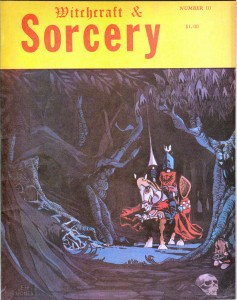
'040 Witchcraft and Sorcery' by cthulhuwho1 on Flickr

‘040 Witchcraft and Sorcery’ by cthulhuwho1 on Flickr

While at PAX East this year, I was determined to play a game of original 1974 Dungeons & Dragons, primarily to be able to say that I’d played it.

Fortunately, I was at PAX East with the Gamer Assembly, and they were interested in the idea, too.

We played the Temple of the Ghoul scenario, my go-to adventure for old-school gaming. It has a skittish village population, an abandoned temple on a hillside, stirges, powerful supplies if the heroes are aware enough to notice them, a kitchen heaped with eviscerated adventurers, and of course, the ghoul.

In the months leading up to PAX East, I spent many hours poring through the original 1974 D&D pamphlets and gleaning the relevant tables and mechanics for the players. The system felt like a dark dungeon itself, full of confusing passages.

At the con, I gave the players a one-sheet summary of the core rules, and that’s what we used in play.

Everyone died in the first fight. Fortunately, the players took this with good humor, and everyone re-rolled characters and dove back in. Within a few hours they had found the ghoul and finished him/it off.

As expected, the system is relatively light and flexible, combat grows dull quickly if all you do is swing your sword, and there are a lot of awkward wargame-y mechanics (most of which we ignored in using my “core rule” sheet).

The system felt half-formed, like a child’s version of D&D. This is nothing against Gygax and Arneson; they were still feeling their way towards a completely new mode of play. Expecting an elegant system by modern standards would be like expecting the Model T to drive like a Jaguar.

Original D&D is a fine bit of engineering, though, that provides the raw mechanics needed to explore a dungeon and quell ancient terrors. If you want a bit of fun, you can find it in D&D.

Red Ax: Who Are Your Characters?

This is part of an article series I’m writing about my upcoming comic book, Red Ax.

Writing has always been an act of discovery for me. I devise a scenario, populate it with characters, and add layers of plot and complication.

The characters begin as cocktail party acquaintances. I can slot them into big buckets: the strong and silent type, the quiet and broken type, the brash and greedy type. As I write, they become friends. I learn why they’re silent, broken, or greedy.

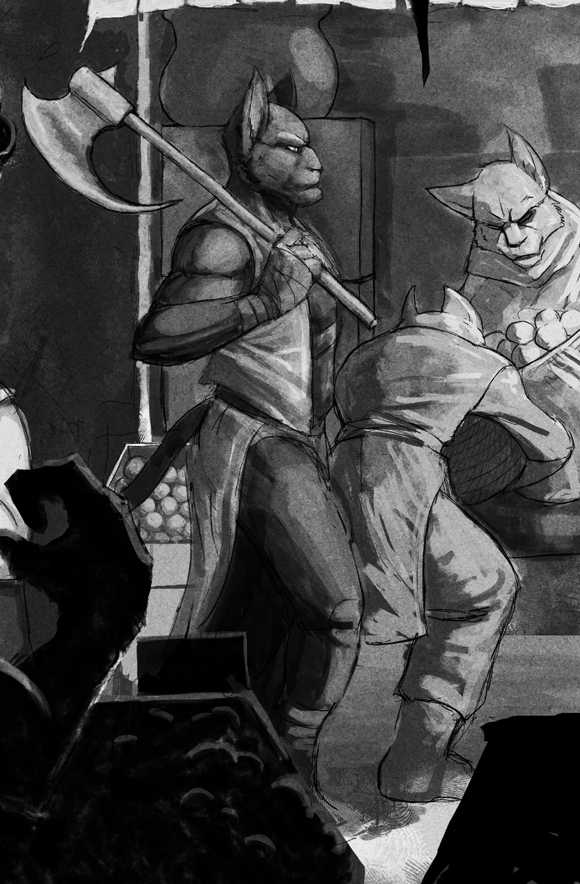
Red Ax, page 1 detail, by H. Davidson

Red Ax, page 1 detail, by H. Davidson

A great example of this is the character of Ax. He’s the hero of the story: a muscled blade-for-hire in a cutthroat world. His chosen weapon is his eponymous ax: a large, curved blade on a six-foot pole. A strange weapon for a strange man.

He’s the strong, silent type in more ways than one: he’s mute.

I don’t (yet) know why he’s mute. When the story came to me, my daemon whispered in my ear and told me that Ax had to be mute. So, he is.

That’s a significant obstacle to story clarity, but not a huge one. Because Red Ax is a comic, the reader gets to hear Ax’s thoughts. Plus, Ax carries a slate and chalk with him.

However, those conveniences create other story issues. A character with a lot of inner dialogue tends to sound like a noir detective. My mind immediately leaps to Sam Spade’s sarcasm. Which is not true to Ax.

Which brings us back to the discovery of character. I’m defining Ax partly by what he isn’t. That’s part of my journey. Ax is taking shape: serious, honorable, and straightforward, adhering firmly to a strong ethical code.

As with most ethical people, this gets him into a lot of trouble. But it’s worth the trouble.

50 Games in 50 Weeks: Take 6

Take 6 is a card game that relies on two left-brained skills, math and probability, which usually cause my brain to leap out of my skull and run away screaming.

The game involves taking a hand of cards, each of which has a number on it from 1 to 104. Each player then lays out a card, in turn, building six columns. When building a column, a higher-value card must go on top of a lower-value one. Once a column contains six cards, the player who laid the six cards gets all the cards in the column (which is bad). The value of all cards in that column are added to that player’s score, along with multipliers represented by flags on the cards. Higher scores lose.

It’s a neat design. I particularly like that there’s only one of each card, so every card is higher or lower than every other card.

There’s a fair amount of tactics to the game, as you’re trying to minimize columns’ value…which may be changed by other players’ cards.

Its fun is directly proportional to how much you like math and probability. So. Best of luck there.

I work for Amazon. The content on this site is my own and doesn’t necessarily represent Amazon’s position.