Archive for September, 2011

50 Games in 50 Weeks: Seven Dragons

Sep 14 2011 Published by under Miscellaneous

Just finished playing a game of Seven Dragons, a strategy card game by Looney Labs. It manages to find an excellent middle ground between ease of comprehension and strategic options.

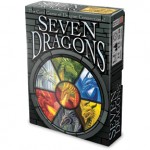
Seven Dragons card game

Seven Dragons © Looney Labs

The rules can be easily explained in 10 minutes (though I botched one of the rules’ aspects). After you begin playing and once you hit the game’s midpoint, your strategic options become complex and interesting.

It’s something of a pattern-matching game. A silver dragon card is placed in the center of the table, then each player draws 3 dragon cards and one goal card (all kept secret from other players). The dragon cards have differently-colored dragon panels on them, and the goal card has one colored dragon. Each turn, each player draws a card into their hand, then lays down a card next to an existing card on the table, with the goal of connecting seven panels that all have the same color as the player’s goal card.

The draw pile also contains action cards that let players swap goals, swap hands, move a card on the table, etc. This makes the latter half of the game particularly intense, as chains built earlier are abandoned for new goals and precise placement becomes much more important to prevent other players from completing chains.

It’s not Risk, of course, but for a US $12-$15 game that you can teach quickly and get through in 30 to 60 minutes, I’m impressed at its depth. Bonus: elements of the system can be easily dropped to make the game easier for kids to understand.

You can buy Seven Dragons directly from Looney Labs.

No responses yet

50 Games in 50 Weeks: Do: Pilgrims of the Flying Temple

Sep 07 2011 Published by under Role-playing

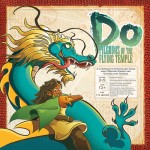
Do: Pilgrims of the Flying Temple

Do: Pilgrims of the Flying Temple

Do simulates a specific fantasy trope: adolescent temple iplgrims who travel the world, helping people and getting into trouble. As limiting as this may appear, it’s easy for folks to grasp and use to tell stories.

The system is much more simple than the length of this review implies, and highly story-focused. Your character is represented by two words: an adjective or verb “banner” and a noun “avatar.” The banner represents how your character gets into trouble, and the avatar represents how she helps people.

That’s it for character creation. There’s no GM, and no combat system. Intrigued yet?

Each story begins with the pilgrims’ receipt of a letter from some community outside their temple. The letter describes some big problem that the community faces (though the letter writer may not be telling the whole truth). From that letter, a set of key words called “goal words” (10 for an easy adventure; 20 for a normal one) have been extracted. The book provides a bunch of sample letters, with goal words pre-extracted.

The system uses no dice; instead, several dozen stones are placed inside a pouch. Black and white go stones are ideal; we simulated them using coin tosses.

Once the pilgrims fly off towards the source of the letter, play begins with the oldest player, then continues to the left in a circle. The current player is the ”storyteller,” while the other players are “troublemakers.”

The storyteller removes three stones from the pouch, and decides whether to take the white or the black stones. Taking the larger number lets you help people and get out of trouble while fewer stones get you into trouble, but once any player collects 8 or more stones, the story is over and the group fails.

Practically speaking, if you take as many stones as possible each turn, you’ll collect too many stones. So, there’s a built-in incentive to get in trouble.

The only part of the system that can’t be quickly memorized is the table that tells you what you do depending on how many stones you take.

That table determines what the storyteller or the troublemakers do next, and it’s determined by how many stones you take and whether you are or aren’t in trouble (a total of 8 scenarios). The storyteller may be able to help someone–perhaps another pilgrim who’s in trouble, or perhaps someone in the world they’re visiting–or the troublemakers may be directed to get the storyteller into trouble. Either (or both) may involve crossing off goal words.

Crossing off goal words is how you get a happy ending: if you cross off all the goal words before any pilgrim gets 8 stones, the pilgrims succeed.

After a few rounds, it becomes clear that the pilgrims are regularly getting into trouble, and each player must, while storyteller, balance helping her friends and moving the story along towards its goal.

There’s a bit more complexity involving the stones you take and how your character changes at the end of the story, which appears lovely but I wasn’t able to test.

The book’s cover claims that it’s aimed at players 12 or older, but I think it’s ideal for kids as young as 8. It’s basically Avatar: The Last Airbender, without the heavy long-term story arc.

Moreover, the system is supported by beautiful artwork that evokes child-like wonder and fantasy awesomeness. This is a book worth owning just for the art; combined with the system it was well worth every penny.

No responses yet

Road Trip, Day 1

Sep 02 2011 Published by under Miscellaneous

I’m off on the first day of my great cross-country road trip. I’ve stopped at a small Italian restaurant in Maryland.

20110902-060245.jpg

No responses yet

Upcoming Project: Voidjumpers of Space

Sep 02 2011 Published by under Role-playing

I’m careful to avoid announcing new products until they’re evolved enough that I’m sure I’ll be able to release them.

I have 38 pages and over 10,000 words in this one, so I’m confident now.

"Flying Imp, Elven Spelljammer" by juanosarg on Flickr

Flying Imp, Elven Spelljammer by juanosarg on Flickr

I’m working on a SpelljammerTM adaptation for Dungeons & DragonsTM 4th Edition. Its working title: Voidjumpers of Space.

First, a few definitions:

Spelljammer was a D&D 2nd Edition supplement for running D&D adventures in outer space. Wooden sailing ships flitted through the spaces between worlds.

This will not be Spelljammer with the serial numbers filed off. This is not a one-for-one conversion. My goal is to accomplish the same basic goals as Spelljammer with new, original content.

Here’s what I’ve got so far:

  • Complete ship combat rules
  • 10 types of ships
  • 18 ship-based weapons
  • 7 new monsters
  • 2 new class themes (I’m particularly excited about these)
  • 10 major space-faring societies, including significant individuals and relationships
  • 8 famous locations in space
  • The Starfire Cluster, a group of 6 worlds intimately connected by major leaders and resources, and ready for adventure
  • 5 campaign ideas

I’ve also statted out several dozen specific monsters and potential enemies. I want this to give you plenty of material to work with, which you can either drop in directly or easily modify to suit your tastes.

When will it be released? When it’s ready. I’ve got a lot of playtesting and massaging of the text remaining.

I’ll post more as I firm up the content. Meanwhile, I’m open to suggestions. Let me know what you’d like to see in the final product!

No responses yet