Archive for July, 2011

50 Games in 50 Weeks: Freemarket

Jul 25 2011 Published by under Role-playing

Freemarket cover

Freemarket © 2009 Luke Crane and Jared Sorensen

As part of RyvenCon, the online gaming con, I played a quick game of Freemarket.

Freemarket’s a fascinating system and world, which I honestly had trouble wrapping my brain around. That’s not a complaint or a suggestion that either system or world are deficient; they’re just sufficiently unusual for me to feel lost on mechanics and their consequences.

Freemarket is set on a space station, in a post-capital society of plenty. Everyone has enough food and clothing. Matter printers can regenerate your body, so you can’t die. There’s no money. You create things, and if people like what you create, they give you “flow,” which can be redeemed for access to more space and certain station resources.

So, you can set up a coffee shop in your tiny living space, and make coffee for people, and do it all for free. You can operate that for years without having to spend money (there isn’t any). But hopefully, folks will appreciate your coffee by donating flow, which you can trade in for a larger space somewhere else on the station.

Back to mechanics. Character creation took about 2 hours. Characters have genelines (a family that suggests their tendencies), experiences (skills), interfaces (internal tech), technologies (physical possessions), short-term memories, long-term memories, a generation, and more. It’s overwhelming.

At the end, though, you have a well-defined personality for your character. Moreover, the character creation process defines the group that the PCs are part of (the ”MRCZ”), so once you’re done creating your characters, you know why they’re all together, and you have some hooks for the story.

The conflict resolution mechanic involves cards, risking tokens, using cards based on tags on your abilities, and a poker-style decision to ”call.”

Each player begins with a couple of cards (based on their abilities), then draws cards each turn. Some cards give you points towards winning the conflict, while others can be used to sabotage or otherwise affect others’ cards. At any time after the first round, anyone can “call,” which ends the conflict. The cards laid out determine the winner(s), loser(s), and effects of the conflict.

This allows for a more nuanced conclusion to a conflict than “I won,” at the expense of a much more abstract, weird process. I couldn’t map the drawing of two cards on my turn to anything in the actual conflict. Granted, that’s probably part of the point.

The system and the setting fit together like a glove, and I love what I saw, but it’s clear this is not a pick-up game. I think I’d have enjoyed it more if I’d played a couple of sessions around a physical table. This is nothing against our wonderful GM Dan; this was caused by Freemarket’s fundamental weirdness as both a system and a setting.

Thanks to Dan Clery the GM, and fellow players Ryven Cedrylle and Adam Minnie.

Purchase Freemarket. More information on the game.

3 responses so far

50 Games in 50 Weeks: #1, Hive

Jul 18 2011 Published by under Miscellaneous

Years ago, I designed a territory-building game, one in which players lay down territory cards, then spawn monsters on them in an attempt to capture another players’ castle. Never went anywhere; turns out that game design is hard.

But as I sat down with a co-worker to play Hive over lunch last week, memories of my territory-building game floated to my mind. This had a similar concept, beautifully realized as a chess-like pure strategy game.

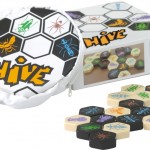
Each player has a set of bakelite hexagonal pieces, each representing an insect. Each player sets down a piece next to each other, then take turns either laying down another piece or moving an existing piece. By the fourth turn, each player must put down their bee, which corresponds somewhat to the king in chess. The object of the game is to surround your opponent’s bee with pieces.

Each piece has its own style of movement. Grasshoppers can jump over any number of continuous pieces to land in an empty position, while beetles can climb on top of other pieces.

There are other rules, but you see the overall shape of the game: the hive grows as the game continues, and the pieces shift based on each player’s strategy. One has to be careful about what piece one moves. What are you leaving vulnerable, and what pieces can take advantage of your new position?

Very young children would probably have a tough time remembering how all the pieces move, but tweens should have no problem playing. Better, the game comes in a vinyl carrying case the size of a hardback book, so it’s easy to take anywhere.

Despite the simplicity of the rules, there are a lot of complexities that arise from gameplay. Because there’s no random element, beginners are at a massive disadvantage against expert players. So be nice if you’re teaching!

One response so far

50 Games in 50 Weeks: Introduction

Jul 17 2011 Published by under Role-playing

"Dice" by ellasdad on Flickr

"Dice" by ellasdad on Flickr

I want to be a better game player, a better GM, and a better game designer.

I’m poor at playing. I just don’t get deeply into my characters, and I don’t remember the system well.

I’m a pretty effective GM, I think, but my narrations are often bland and I hesitate often. I don’t prove a smooth play experience.

I need exposure to a lot more games to have a sufficiently large toolbox of mechanics to use when designing games.

One of the best ways to improve is through experience, so I’ve set myself a challenge:

By the end of July 2012, I will play 50 games that I’ve never played before. They can be card games, board games, or role-playing games, but because I’m most interested in RPGs, I’ll focus on those.

I’ll write about each game I play. RPG posts will be posted on The New Haul, while board/card game articles will be posted back on my regular blog. I hope you’ll follow me on my journey.

No responses yet

An All-Digital RPG: The Flip Side

Jul 13 2011 Published by under Role-playing

"Shanghai | Hazy Lujiazui - PuDong, Shanghai" by Ikiller123 on Flickr

"Shanghai | Hazy Lujiazui — PuDong, Shanghai" by Ikiller123 on Flickr

I wrote a little while ago about a model for an RPG handled entirely via apps and software, in which all the mechanics are run by computers and the humans just see the results.

This is conceptually elegant; let computers handle the number-crunching they’re good at.

But there are problems.

For one, the system has to have apps for many different devices. In the current market, that’s a lot of work. This means, at minimum, an iPhone app, an iPad app, and at least one Android app for each major version of Android on phones out there.

(Required caveats: Yes, I know you can develop one app for both iPhone and iPad, but you need separate UI designs for each class of device to be effective. I’m not familiar with Android development, but I understand that different phones are locked into different major versions of Android, so you can’t always have one Android app for every Android phone.)

You have to get every single player to download the apps, set them up, etc. It’s not as easy as loaning someone a book and a printed-off character sheet. Harder adoption rate.

If it’s a paid system, the developer has to choose effective prices, which would be harder in an unproven frontier like this than in the more tried-and-true markets that currently exist. What are players willing to pay for? Which parts of the system do you charge for?

GMs can’t fudge the system, or invent their own house rules. This is a major problem for a lot of gamers; adjusting a game to one’s play style is an important part of the experience. Can a system be built that people wouldn’t houserule?

You have to trust the software. When every calculation is opaque, it’s easy to wonder how fair the software is. Or if you’ve set up your character correctly.

No responses yet

An All-Digital RPG System

Jul 07 2011 Published by under Role-playing

Imagine an RPG system that’s handled completely with digital tools. Not only is your character sheet displayed on a screen, the mechanics are handled there, too.

Imagine this: a group sits around a table, each participant holding a smartphone, PDA, or tablet.

The GM touches “Moderate difficulty” on his tablet and asks Maria for a Perception test. She touches her Perception stat; it immediately rolls and flashes the result, “19,” at her. A wireless message is sent through the ether, and the GM sees “Success!” on his tablet.

Everything would run on an app. Characters could be created directly on these devices, or developed on a desktop or laptop then accessed on those devices.

How about a virtual tabletop? This is a bit harder to envision, but it’s certainly possible that a company will build and sell a tablet that’s much larger than today’s iPads. Such a thing could easily be used as a virtual tabletop, and wirelessly sync with each players’ device to automatically show markers, bloodied creatures, etc.

These digital systems would revolutionize LARPing. Just reach into your pocket and touch your smart phone to determine if you hit or miss an opponent.

(Obviously, there’d be purists; this wouldn’t kill traditional LARPing. But it could add a new experience.)

The technology is really already in place for all of this. Would it work? That’s another post.

No responses yet

A Personal Plea From Me To You

Jul 05 2011 Published by under Self-improvement

I’ve been reading personal improvement books lately. They’ve inspired me to pass along a recommendation that I hope you–yes, you, reader–will take to heart, think about, and implement.

Stop watching TV.

Completely.

Give your TV(s) away, if you can.

“But there’s good stuff on TV,” some proclaim. Yes, there is. There’s also good stuff in books and in movies. The problem is not the content; it’s the method of delivery.

You know all this. This sounds stupid. But this one stupid thing will suddenly give you the time to do all those things you want to do. Seriously.

One response so far