Archive for April, 2010

Why Who?

Apr 26 2010 Published by under Miscellaneous

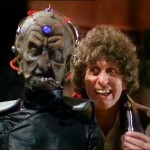
Doctor Who, Tom Baker

Tom Baker as Doctor Who

Decided to relax last night and watch a few episodes of classic Doctor Who.

(Yes, yes, the new Doctor Who is great. Thank you.)

Why should I watch classic Doctor Who? It’s cheesy, over-acted, and low-budget.

Watching classic Doctor Who is like reading second-tier science fiction. It may not blow your mind, but it’ll have a few memorable moments, a nice monologue, and an interesting premise or two. In addition, that will all be wrapped in a fun adventure story. Never underestimate the value of a fun adventure story.

Saalon‘s been reading Lensman, and he knows what I’m talking about. Lensman is just plain great fun.

And what’s wrong with that? I ask seriously. I feel like watching a cheesy, fun show with some good acting (at the very least, the Doctor is nearly always fascinating to observe) and an occasional deep twist needs to be defended. People turn up their noses at that, then glue themselves to the TV to watch American Idol or spend hours playing Bejeweled.

No responses yet

Pics and Punchlines

Apr 21 2010 Published by under Miscellaneous

Just stumbled across a stunningly different photo blog — the photographer works in Japan, taking photos of everyday people and situations on the street.  The color’s always unexpected, and the subjects atypical.

Warning: Some of these photos show naked dolls, so if you don’t want to see doll breasts and butts, don’t click below:

Pics and Punchlines

A sample:

Untitled photo by Andrew Houston

Untitled photo by Andrew Houston

No responses yet

Well That Was Easy

Apr 09 2010 Published by under Technology

Phantasy Star II screenshotAs mentioned in my previous entry, I downloaded the iPad/iPhone SDK Thursday night, and played around with it.

I now have a simple text adventure for the iPad, complete with four rooms and an inventory. In less than 24 hours.

I struggled with a few things. One has to go through several steps to wire up a UI element like a button or text view. Each module and model has its own role to play, and their interactions often confused me. Often, a button simply wouldn’t respond to system events, because I hadn’t done all of that wiring.

But I was able to get a simple game up and running in a couple of hours. Apple’s got some impressive tools and documentation.

No responses yet

Wet Toes

Apr 08 2010 Published by under Technology

"DSCF3811" by Walter-Wilhelm on FlickrIn a fit of curiosity and a desire to seriously research a new field of programming, tonight I downloaded the iPad SDK and built a trivial iPad app.

As expected, Apple made development relatively easy. The free development tools are comprehensive and easy to use. Also as expected, I’m still confused by all the files that go into an app. There are nibs, and Resources, and all sorts of things that simply don’t have obvious functions.

I decided to read Apple’s development guide carefully. As a coder, I’ve developed the habit of skimming the documentation, which makes sense most of the time; during normal development, I’m looking for that one fact or code snippet that will solve my current problem. But for a new field, and just generally for my benefit, I’m drinking slowly and deeply this time.

The guide is clear, concise, and helpful. It’s not quite up to the standard set by Be’s API documentation, but nothing else since has been. A close reading of Apple’s guide told me the vast majority of what I needed to know to move forward.

So, my first app displays a logo screen, then two colored boxes. That’s it. I plan to expand it into a simple text adventure, which looks achievable at this point.

Realistically, I think the major hurdle will be learning Objective-C, which still feels like an awkward, uncouth dialect to my programming fingers. But hey, if I can learn LISP and assembly, I can learn Objective-C, right?

2 responses so far

Meeting the Robinsons

Apr 08 2010 Published by under Reviews

Growing up, I wanted to be an inventor.

I think it started with my Mom giving me a copy of Jules Verne’s 20,000 Leagues Under the Sea, saying, “I think you’ll like this.”  Did I ever.  I devoured Verne and H.G. Wells, then moved on to more modern SF literature.

I was attracted to the role of the inventor, always coming up with new inventions.  I knew it wouldn’t be as simple as it was in the cartoons I watched (“Today, I’ve invented a shrinking ray!”).  But I loved the idea of playing around with technology.

That’s probably why I was so attracted to programming when I got a computer a couple years later.  With software, I wasn’t limited by physics or natural laws; I could make just about anything happen.  I never got into the hardware or electrical side of things, something I now mildly regret.

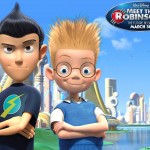
Meet the RobinsonsWhich is why I was initially attracted to the trailer for Disney’s Meet the Robinsons, a CGI feature from several years ago.  It had some odball humor — like the Tyrannosaurus Rex villain complaining about his stubby, useless arms — and a kid inventor protagonist.  But I was worried that the kid would be a Jimmy Neutron knock-off, always rocketing around in inventions of his own making.

That’s not Meet the Robinsons.  Lewis, the protagonist, is a deeply conflicted 12-year-old: an orphan whose inventions have never worked. He sees himself as a failure with no identity.

Those become the film’s themes: failure and identity.  What is failure?  And are we determined by our genes or our choices?

In my opinion, this is a Pixar-quality film.  Now, I personally don’t deify Pixar.  While I enjoy all of Pixar’s films, a couple of them (A Bug’s Life, Finding Nemo, and Monsters, Inc.) never grabbed me.

This flick grabbed me. Lewis is instantly likable, from his love of technology to his passion for invention and improving the world.  He’s a kid, which a lot of kids’ films seem to forget about. He’s innocent without being naïve.

He also genuinely hurts.  He’s not a genius adventurer; he’s a flawed boy, who is also a genius and goes on an adventure.  There’s a huge difference, and it’s a hallmark of Pixar-like storytelling.

I’ve long said that Disney animators could animate rocks effectively, and Meet the Robinsons proves it.  Despite being relatively unfamiliar with CGI, the animators bring emotion and reality to the characters. For example, during a scene with one primary character, secondary characters react and go through their own emotional arcs while in the background. And they don’t follow familiar facial reactions.

Note:  Brad Bird, director of The Incredibles, was once asked to identify the biggest strength and the biggest weakness of the newest generation of animators. He replied that it was the same thing: we have decades’ worth of animation that we can study, and it can be done by pausing DVDs at its simplest level. But that study can lead to imitation. He described watching current animated films and saying to himself, “Okay, there’s walk #5, and there’s shocked expression #3, and there’s grin #6.”

Now, John Lasseter was heavily involved with this film, and according to IMDb was responsible for reshoots on 60% of the footage.  But those were larger creative directions for the story, not directives for individual animators.  This film demonstrates tremendous craft.

And the story’s inspirational.  It’s about simple truths, told in a way that’s affecting, memorable, beautiful, and touching. I teared up at the end, because the end celebrated the tremendous potential of humanity.

No responses yet

15 Thoughts on the iPad (updated)

Apr 06 2010 Published by under Technology

The iPadA dry description of the iPad’s actual features and usability will not sell anyone who doesn’t want one.

Nevertheless, here’s a list of my impressions:

  • It’s slick. This is what Apple can do: make something we’ve all seen demos of feel not only practical, but sexy.
  • Every basic part of the device works well, and the hardware feels more solid than the iPhone’s. The accelerometer feels more sensitive and the screen crisper than an iPhone.
  • The apps work as advertised.
  • Typing is easy. Not awkward at all.
  • The screen can get smudged easily, but really, there are worse burdens to bear in this life.
  • It doesn’t feel heavy to me, considering the fact that it’s basically a laptop screen.  Some Kindle users complain that it’s heavier than a Kindle 2, and that’s certainly true; I wouldn’t want to hold this upright with one hand for hours.  But that’s fine; it is basically a laptop screen.  It’s not going to be light.
  • Games normally hold little attraction for me anymore, but with the iPad I’ve gotten back into gaming a bit. I’ve logged several hours on Warpgate HD, a Privateer-like space trading and combat game. The Pac-Man emulator works perfectly. Mirror’s Edge is a disappointment (they turned it into a side-scroller), and FPS’s are just too hard to control.
  • The Kindle app looks gorgeous. Works flawlessly, too.
  • I still prefer my Kindle DX for reading. The solid state screen on the Kindle is much easier on the eyes for long periods.
  • I’ve been using Evernote for my Getting Things Done to-do lists. Works fine so far. Great having my lists on an ultraportable device, and the ability to easily add, change, and remove items is an advantage over paper.
  • There’s an app called Comics, which lets you read American comics. Wow. I read through the first issue of a Warren Ellis-written Iron Man story, and…well, for US $2 I could download and read an issue of Iron Man. Tremendously valuable. You can double-tap on a panel to zoom in on it, too.
  • I watched the first few minutes of The Big Sleep using the NetFlix app (which also lets you manage your queues as effectively as on their website). I like the idea of being able to watch TV shows and movies on the iPad, though I don’t know why I’d do so there instead of on my larger laptop or projector.
  • You can load any iPhone or iPod Touch app on the iPad, which can be doubled in size to take up the full iPad screen real estate. This looks acceptable for most apps, but for games, the effect is cartoony and pixellated.
  • An option in iTunes will automatically down-sample all MP3s to 128 mbps when transferring to the iPad. I went from about 28 GBs of music (which is just a subset of my collection) to about 8 that way; I think I can put all my music on the iPad.
    • For you non-techies, let me translate: 128 kbps is a relatively high quality rating, but many songs files are generated at an even higher quality.  There’s a checkbox in iTunes that, when checked, will convert any songs higher in quality than 128 kbps to 128 kbps before transferring them to the iPad.  This can save tremendous amounts of storage space.
  • The lack of Flash is something of a relief. I get fewer annoying, interactive banner ads. The video sites that I care about (YouTube, Vimeo) already support HTML 5 video, and I hope that will be the future of online video anyway.

Overall: Do I like it? Yes. Is it worth the money? That’s an individual decision. It’s worth my money, if just because I get to hold a bit of the future in my hands.

No responses yet

Gaming the Social

Apr 05 2010 Published by under Role-playing

"2008 Renaissance Festival 100" by anoldent on FlickrI’ve become interested recently in the topic of role-playing social interactions. In a tabletop RPG, characters often have to talk with enemies as well as short-term antagonists — the arms dealer who’s willing to cut them a deal, the mayor from whom they need permission for an investigation, a boy who doesn’t want to talk.

A good example has just come up in my Star Wars Google Wave game; while investigating the disappearance of several Adascorp freighters–in which the Hutts looked to be involved–the players accepted a job delivering a strange package to someone named Klek. They found the bar where Klek lived, were sent into a back room, and were greeted by Klek the Hutt.

How do players deal with that sort of situation? Wouldn’t it be cool if a role-playing system provided specific mechanics to help the players wrap their brains around the challenge, in the same way that they provide mechanics for physical combat and uses of skills?

Note:  Yes, this could be treated like a skill challenge in D&D 4E, but skill challenges have simple binary outcomes. You succeed or you fail. Social interaction is never that simple.

In pursuit of this, I bought a copy of Blue Rose, “the role-playing game of romantic fantasy,” which focuses more on court intrigue than combat. Great! Then I discovered it uses a minor variation on the True20 system. I love True20, but I’m looking for something more tailored than that.

So I spent some time last week hashing out some variables for a social-oriented system. Here’s what I’ve got so far:

Character Attributes

Each player-character has six characteristics:

  • Honor
  • Beauty
  • Psychic/Magical Ability
  • Charisma
  • Craftiness
  • Physical Endurance

To determine your character’s stats in these, roll a d100 (or a percentile die and a d10) for each of the above attributes. If all six rolls total 500 or more, re-roll. A low score indicates a low ability; a high score indicates a high ability.

Note: I’d like to add charts for each of these characteristics, indicating the overall distribution of these numbers across the population. Someone in the lowest 5% of psychic ability, for example, is anti-psychic; no psychic abilities can be used within 10 meters of the individual. Someone in the highest 93% are particularly gifted.

In addition, each character rolls a d100 for each of three types of resources:

  • Knowledge
  • Money
  • Influence

That influence score can then be divided amongst the various organizations over which the character has influence, depending on the setting.  For example, in a Medieval European setting where one plays a noble, one may have influence over one’s serfs, the clergy, and the crown.

Each character also has at least one character goal.  These are all in-world accomplishments of any scope; rescue the princess, become a knight, make a million credits, or atone for my past sins.

Moreover, each character maps his or her relationships with the other notable characters and groups in the game, on a scale of -4 (worst enemy) to +4 (best friends/intimate lovers), and an emotional bank from 0 to 5, indicating how much energy they’re willing to devote to social interactions. I’m not sure whether the emotional bank should be one overall score, or individualized to specific people and groups.

"So where do you want me to go?" by "Mercedes.. Life as I picture it" on FlickrPlaying a Social Conflict

When a social conflict begins, each side in the conflict determines their conflict goals, such as ”Increase the Queen’s relationship with me to +1″ or ”Find out what Don Ferrigno knows about the death of Jericho Fats.”

Character goals are kept hidden (unless they’re generally known), but may be revealed during the conflict.

There are no die rolls during a social conflict.  Each character asks for help, offers information or resources, etc., which may or may not be accepted by the other characters.

Doing a small favor for someone may increase that character’s emotional bank by 1; a big favor by 3.  Once the emotional bank hits 5, the relationship score increases by one rank and the emotional bank resets to 1.  If the emotional bank drops below 0, the relationship score decreases by one rank.

As characters interact with the world, their resources change. Their characteristics can also be affected, of course.

Were I to include a combat mechanic, I’d use something like Fudge: each weapon provides a small bonus (+1 to +3), as does significant armor.  Roll Fudge dice (which provide -4 to +4), add the result to any weapon bonuses, and compare to the opponent’s armor value. If you meet or beat the armor rating, you hit. There are enough damage systems in the world that I leave that to the reader’s imagination.

What do you think?

One response so far